Reference Decision: cc • No. 85-94.625 • 1986-05-27 • View the decision →
Imagine the scene: you have just bought a house with a swimming pool in Saint-Pierre-des-Corps, and to protect your children, you decide to build a small semi-underground shelter in concrete and stone, just big enough to store the maintenance equipment. You think it goes without saying: it is so small that planning permission is not necessary, right?
Wrong. As this decision of the Court of Cassation of 27 May 1986 shows, this type of construction can get you into serious legal trouble if the dimensions exceed the thresholds set by law. And just because the regulations change along the way does not mean that proceedings already brought are extinguished.
This case, which pitted a homeowner against the administration, raises a crucial question: how far can you build without permission? The answer lies in figures — 2 square metres of floor area and a maximum height — and in the fact that new laws cannot erase offences committed before they came into force.
The Facts: A Story Like Many Others Every Day
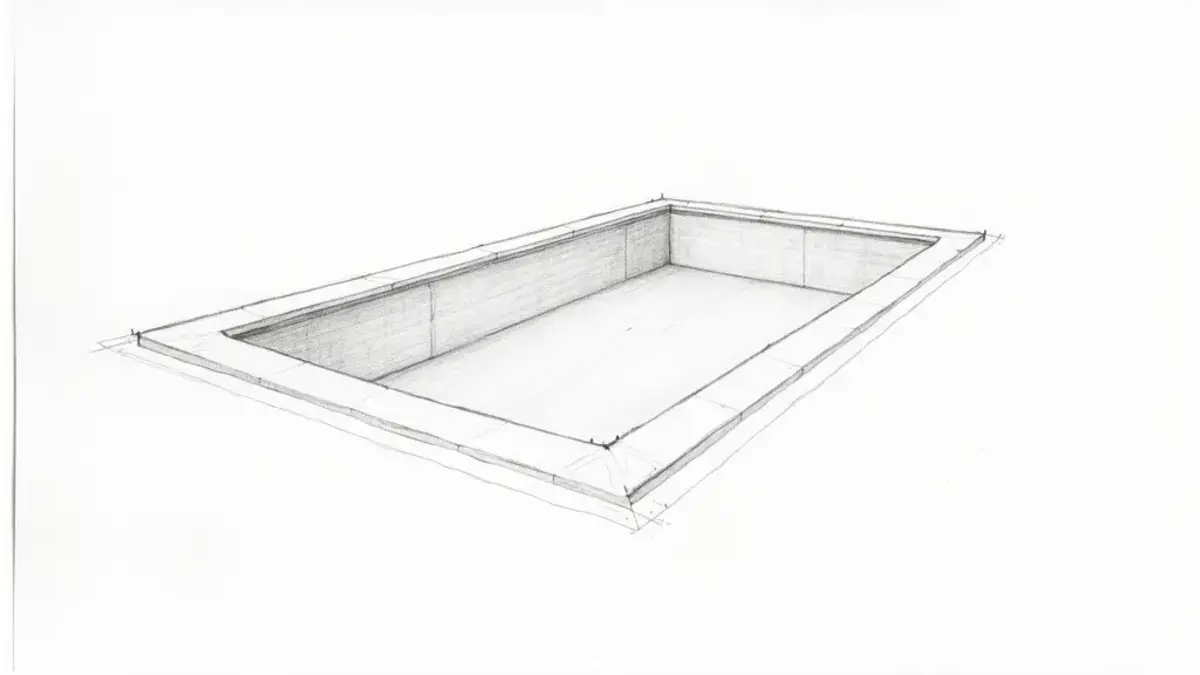
Mr X is the owner of a house with land in Tours. In 1983, without applying for any planning permission, he had a semi-underground concrete and stone structure built around his swimming pool. Not a garden shed, no: a solid structure, half-buried, serving as a plant room and storage. The problem? Its floor area exceeded 2 square metres, and its height also exceeded the exemption thresholds provided for by the decrees then in force.
The mayor of Tours brought criminal proceedings for breach of the Town Planning Code. Mr X was convicted at first instance, then on appeal. But in the meantime, on 6 January 1986, a new law amended Articles L. 421-1 and L. 422-2 of the Town Planning Code, and two decrees (No. 86-72 of 15 January and No. 86-154 of 14 March) specified the new exemptions. Mr X then hoped that these more favourable texts would put an end to the proceedings.
The Court of Appeal rejected this argument: the judges noted that the area and height of the structure were greater than the maximums set by both decrees, even the most recent ones. In other words, even under the new rules, the construction would have required permission. Mr X appealed to the Court of Cassation.
The Reasoning of the Court — Analysed
The Court of Cassation upheld the appeal judgment. Its reasoning is simple but relentless: the new legislative and regulatory provisions cannot affect ongoing proceedings when, in any event, the disputed structure does not meet the exemption conditions. In short, even if the law changes along the way, if your construction exceeds the exemption thresholds under both the old and the new regime, you cannot rely on the new law to escape liability.
The legal basis is Article L. 421-1 of the Town Planning Code (in its applicable version), which makes all construction work subject to planning permission, except for exemptions. The exemption decrees set thresholds: floor area less than 2 m² and limited height (generally 1.50 m or 2 m depending on the case). The judgment recalls that these thresholds are cumulative: it is enough for one to be exceeded for permission to be required.
The lower courts had found that the area of the building was greater than 2 m² and its height also. Therefore, it did not matter that the decrees had been amended: the offence existed both before and after. The Court of Cassation therefore dismissed the appeal. This decision is a confirmation of previous case law: no reversal, but a strict application of the principle of non-retroactivity of more lenient laws in criminal matters, tempered by the finding that the offence continues under the new law.
A rhetorical question arises: what is the point of changing the law if the judges can always go back to the facts? The answer is that the new law may be useful for future constructions, but not to erase the past when the offence is established.
What This Means for You — Practically
For homeowners, this decision is a warning: do not rely on preconceived ideas about 'small constructions'. A pool shelter, a garden shed, a prefabricated garage: even if you think it is 'too small to need permission', check the thresholds. In Tours, for example, a client recently told me he had installed a 3 m² chalet to store his gardening equipment: he had to make a prior declaration and, failing to do so, was fined €1,200.
For buyers, before buying a house, check that all existing constructions (sheds, extensions, swimming pools) have been authorised. A seller who has built without permission may pass on a risk of prosecution or demolition. In Saint-Pierre-des-Corps, a buyer had to demolish a non-compliant 4 m² shelter at a cost of €3,500, even though the sale had already been completed.
For tenants, if you rent a house with outbuildings, make sure the landlord has the necessary authorisations. In the event of a problem (non-compliant swimming pool, illegal construction), you could be held liable as an occupant, even if you are not the builder.
If you are in this situation, you must act quickly: criminal proceedings for lack of permission can last several years, and fines can reach several thousand euros, not to mention the obligation to demolish. A concrete example: in Tours, a 5 m² construction resulted in a fine of €5,000 and reinstatement within 6 months.
Four Tips to Avoid This Type of Dispute
- Before building, measure precisely: floor area (in m²) and height (in m). Compare with the thresholds in force (2 m² and 1.50 m or 2 m depending on the case). If in any doubt, make a prior declaration at the town hall.
- Consult the Local Town Planning Plan (PLU) of your municipality: certain areas (listed sites, surroundings of monuments) require permission even for small constructions. In Saint-Pierre-des-Corps, the PLU may be more restrictive than the national code.
- If you are buying, require a town planning certificate or a statement from the seller on the existence of permissions for all constructions. You can also ask for a visit to the town hall to check compliance.
- In the event of a dispute, do not count on a change of law to save you: as this decision shows, if your construction exceeds the thresholds, you will be convicted regardless of the version of the texts. It is better to regularise beforehand.
Besoin d'un conseil personnalisé ? Contactez Maître Zakine — première consultation 30 min à 45€.
Further Reading: Related Case Law and Developments
This decision is part of a series of Court of Cassation rulings on planning permission exemptions. For example, in a judgment of 12 July 1985 (No. 84-92.100), the Court had already held that constructions intended for agricultural use must comply with specific thresholds, and that exceeding them triggers the obligation to obtain permission. Similarly, a judgment of 3 December 1987 (No. 86-91.456) clarified that uncovered swimming pools are not exempt if their area exceeds 10 m².
The trend of the courts is clear: judges strictly apply the thresholds, with no leniency for good-faith owners. Town planning is an area where the rule is a matter of public policy: you cannot ignore it by pleading ignorance. Since 1986, the thresholds have been amended several times, but the principle remains: no construction without authorisation if the dimensions exceed the minima.
For the future, case law tends to harden with the rise of environmental and landscape concerns. Constructions, even very small ones, in sensitive areas (coastline, mountains, proximity to monuments) are increasingly subject to permission, even below the national thresholds.
Summary and Next Steps
What to do if you are being prosecuted for building without permission:
- Do not ignore the summons: respond within the deadlines (usually 15 days to 1 month).
- Check the dimensions of your construction: if it is below the thresholds, you can invoke the exemption. If it exceeds them, seek a settlement or regularisation.
- Consult a lawyer specialised in town planning law: they can negotiate with the administration or prepare your defence.
- Anticipate the costs: fine (up to €6,000 for an individual), demolition costs (often several thousand euros), lawyer's fees.
Are you in a similar situation? A first 30-minute consultation with Maître Zakine (€45) can save you months of proceedings — and often much more. Book an appointment →
📌 Does this apply to your situation? Maître Cécile Zakine, French real estate lawyer, practises throughout France.
servitude-droit-passage-avocat/" rel="dofollow">→ Avocat servitudes & foncier |
→ Browse all our legal articles
