Reference Decision: cc • No. 74-10.680 • 1975-06-25 • View decision →
Imagine: you are a motorist driving peacefully in Prades, heading towards Cabestany. You respect the speed limits, you are on a permitted road. Suddenly, an ambulance emerges from a prohibited road, all its flashing lights on but siren off. The collision is inevitable. Whose fault is it? For many, the answer seems obvious: the ambulance has its lights, so it has priority, right? Yet the Court of Cassation decided otherwise, and has done since 1975. This decision, little known to the general public, reminds us of a fundamental rule: priority is not obtained by the mere presence of a rotating light. It requires that all necessary signals be used, depending on the circumstances. So, what must a priority driver actually do? And you, as an owner or tenant, how can you protect yourself if you are involved in such an accident?
This question arose in a recent case in Cabestany: a car owner whose vehicle was hit by an ambulance with all sirens blaring, but which was driving the wrong way on a pedestrian square. The insurance company refused to pay out, arguing that the ambulance driver had committed a fault. The matter was settled amicably, but it illustrates the legal grey area surrounding such situations.
The decision of 25 June 1975 (No. 74-10.680) is a true guide for trial judges. It specifies that a simple rotating light — optional at the time — is not enough to claim priority under Article R. 28 of the Highway Code (now R. 415-12) if the circumstances require the use of the audible warning device. In this case, the ambulance was travelling on a prohibited road, which made the siren essential to warn other road users. By not using it, the driver committed a fault that was the exclusive cause of the damage.
The Facts: A Story That Happens Every Day
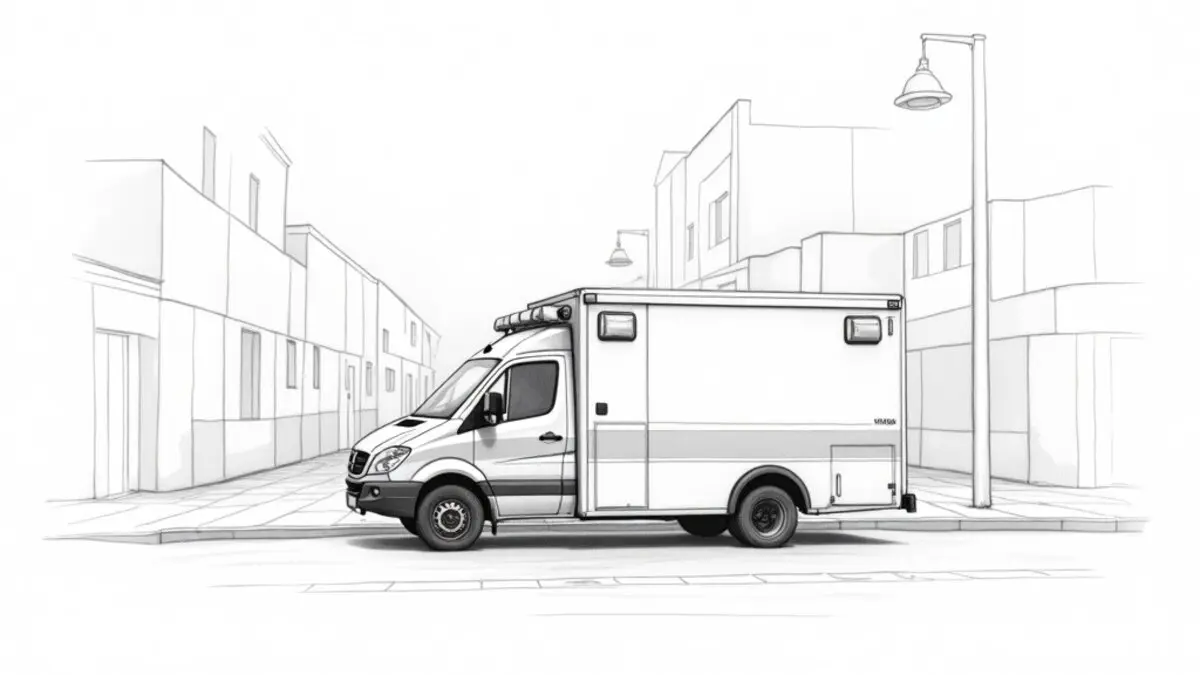
We are in the 1970s, in a municipality in the south of France. Mr X, owner of a converted ambulance, is called to an emergency. In a hurry, he decides to take a road prohibited to traffic — a one-way street or a pedestrian street, the judgment does not specify. He activates his rotating light (flashing light) but forgets to turn on his siren. At that moment, another driver, Mr Y, is driving lawfully on that same road, perhaps a local resident returning home to Cabestany. The two vehicles collide. Material damage is significant, and there may be personal injuries.
Mr X, relying on his status as a priority vehicle driver, believes that Mr Y should have given way to him. He sues Mr Y for damages. The Tribunal de grande instance of Perpignan, and then the Court of Appeal of Montpellier, rule against him: they hold that Mr X committed a fault by not using his audible warning device, and that this fault was the exclusive cause of the accident. Mr X appeals to the Court of Cassation, but the Court of Cassation dismisses his appeal on 25 June 1975, upholding the trial judges' decision.
The reasoning is simple: former Article R. 28 of the Highway Code provides that drivers of priority public interest vehicles may depart from certain rules, but only on condition that they use their special warning devices. If the circumstances require the use of the audible warning device (here, the prohibited road), its absence renders the manoeuvre faulty. The priority driver then becomes responsible for the accident.
The Reasoning of the Court — Analysed
To understand this decision, we must delve into Article 1240 of the Civil Code (formerly 1382), which provides that "any act of man which causes damage to another obliges the person through whose fault it occurred to make reparation." This is the principle of civil liability. Here, the fault is that of the ambulance driver: he used a prohibited road without using the siren, when it was essential to alert other road users. The Court of Cassation specifies that the rotating light alone — which was optional at the time — is not enough to benefit from the priority under Article R. 28. In other words, the priority driver must use all available means to signal their approach, depending on the danger.
The trial judges considered that, in these circumstances (prohibited road), the ambulance driver should have used his audible warning device. By failing to do so, he committed a fault that caught the other driver off guard, who could not reasonably anticipate the ambulance's arrival. The Court of Cassation upholds this reasoning: it dismisses the appeal, finding that the trial judges legally justified their decision.
This decision is neither a reversal nor an evolution: it confirms consistent case law. Indeed, as early as 1959, the Court of Cassation had held that a priority vehicle driver must exercise caution and cannot rely on their priority if they have not taken the necessary precautions. Here, the simple rotating light without a siren is deemed insufficient. The decision is therefore in line with this case law.
What This Changes for You — Practically
If you own a priority vehicle (ambulance, fire engine, police, etc.) or drive such a vehicle, this decision directly concerns you. It reminds you that you must use all special warning devices at your disposal, depending on the circumstances. A simple rotating light is not enough if the situation also requires the siren. For example, in Cabestany, if you cross a pedestrian zone, you must absolutely activate the siren, even during the day. Otherwise, you will be considered at fault in the event of an accident, and your insurance may refuse to compensate you or even seek recourse against you.
For private motorists, this decision is a protection. If you are involved in an accident with a priority vehicle that did not use its siren when circumstances required it, you can challenge its liability. You are not automatically at fault. Keep in mind that priority is not absolute: the priority driver must act so as not to surprise other road users. If in doubt, photograph the scene, collect witness statements, and contact your insurer promptly.
In terms of timeframes and amounts, note that compensation for this type of accident can range from a few hundred to several thousand euros for material damage, and much more for personal injuries. If the priority driver's exclusive fault is established, you can obtain full compensation. But beware: the procedure can take several months or even years, depending on complexity. It is therefore essential to document the accident thoroughly and consult a specialist lawyer.
Four Tips to Avoid This Type of Dispute
- For priority vehicle drivers: systematically activate the siren when using a prohibited road or dangerous area, even if the rotating light is on. Never take priority for granted.
- For private motorists: in the event of an accident with a priority vehicle, check whether all warning devices were used. Take photos and note the circumstances (time, visibility, type of road). Do not sign an accident report acknowledging your liability without legal advice.
- For insurers: train your experts on this case law. An ambulance without a siren on a prohibited road can be 100% liable, even if it has the rotating light.
- For owners of priority vehicle fleets: incorporate this rule into your internal procedures and driver training. An accident avoided means costs saved and lives saved.
Further Reading: Related Case Law and Developments
This decision is part of a consistent line of authority. As early as 1959 (Civ. 2e, 4 March 1959, No. 57-10.680), the Court of Cassation held that a priority vehicle driver must "use his special warning devices in such a way as not to create an abnormal danger." More recently, in a judgment of 12 June 2014 (No. 13-18.496), the Court specified that a simple rotating light is not enough if circumstances require the siren, particularly in built-up areas or on a one-way street. The trend is therefore towards increased accountability of priority vehicle drivers. In future, one can expect courts to require combined use of light and sound signals in almost all cases, except perhaps in open countryside with perfect visibility. For owners and drivers, this means that prevention is better than cure: systematic siren use in urban areas or on prohibited roads.
Frequently Asked Questions
- Is a rotating light alone sufficient to have priority? No, if circumstances require the use of the siren (prohibited road, reduced visibility, etc.), the simple rotating light does not confer priority.
- What should I do if I am hit by an ambulance without a siren? Do not admit liability. Take photos, collect witness details, and contact your insurer. Consult a lawyer to assess the priority driver's fault.
- Can I be prosecuted for failing to give way if the ambulance has no siren? No, if the ambulance does not use the required signals, you are not obliged to give way. You may even be compensated if you suffer damage.
- Does this case law apply to police or fire service vehicles? Yes, all priority public interest vehicles are concerned. The rule is the same: warning devices must be used appropriately to the circumstances.
- What are the time limits for challenging an accident report? You generally have 5 days to challenge an amicable report, but for legal action, the limitation period is 10 years for personal injuries and 5 years for material damage (since the 2018 reform).
Are you in a similar situation? A first 30-minute consultation with Maître Zakine (€45) can save you months of proceedings — and often much more. Book an appointment →
📌 Does this apply to your situation? Maître Cécile Zakine, French real estate lawyer, practises throughout France.
→ Prendre rendez-vous pour une consultation |
→ Browse all our legal articles
