Reference Decision: cc • No. 84-14.522 • 1985-11-19 • View decision →
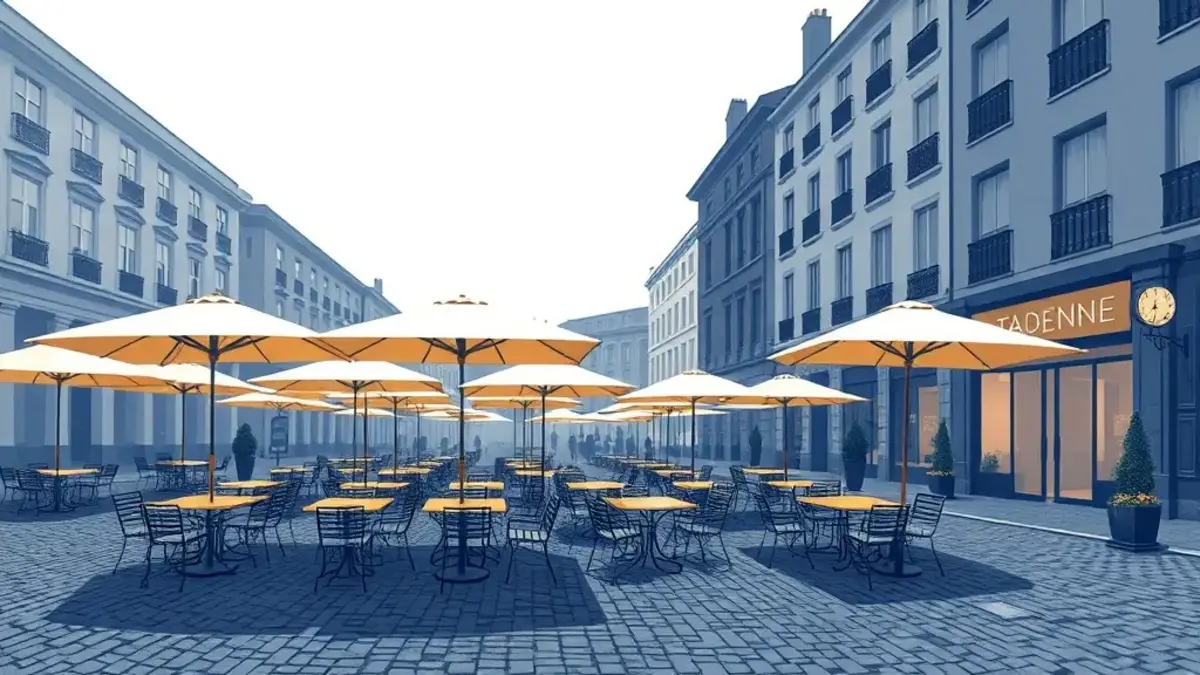
Picture the scene: you own a bar-brasserie in Dax, in the town centre, with a beautiful terrace overlooking the arenas. To make ends meet, you sublet a corner of this terrace to a waffle seller. All goes well, until the day the waffle seller claims the status of commercial leases (which protects the tenant against eviction and gives him a right to renewal of the lease). You are flabbergasted: you thought you had simply a precarious agreement, not a real commercial lease!
This situation, more common than one might think, raises a crucial question: can a terrace installed on the public domain (pavement, square, communal space) be the subject of a commercial lease? The answer, given by the Court of Cassation in a judgment of 19 November 1985, is clear: no, because the owner of the terrace (the café owner) is not the owner of the ground, and the status of commercial leases requires that the lessor be the owner of the leased premises.
But what exactly does this change? And how to avoid ending up in this type of dispute? I will tell you this story as if it were happening today in Saint-Paul-lès-Dax or Mont-de-Marsan, and explain step by step the legal consequences. Because, in my practice, I have come across cases where operators of food trucks or market stalls believed they benefited from the protective status, only to be disappointed.
The Facts: A Story That Happens Every Day
In this case, the company Select-Latin operated a café-brasserie, with a concession on the public domain to install a terrace. It granted, by an agreement, a space on this terrace to a third party, Mr. X, who operated a waffle business there. In exchange, Mr. X paid rent. Classic, right?
But the problem arises when Mr. X wants to assert his rights: he considers that the agreement is a commercial lease (i.e., a contract for the rental of commercial premises, giving the right to the protective status provided by the decree of 30 September 1953). He therefore claims payment of an eviction indemnity (sum due by the lessor if he refuses to renew the lease) or renewal of the lease.
The company Select-Latin refuses, arguing that the agreement concerns a space on the public domain, and that it is not the owner of the ground. The case therefore goes to court: first the Court of Appeal, then the Court of Cassation.
The Court of Appeal rules in favour of the company Select-Latin: it considers that the agreement is not a commercial lease, because the lessor (Select-Latin) is not the owner of the rented space (the ground of the terrace belongs to the municipality). Mr. X appeals to the Court of Cassation. But the Court of Cassation upholds the Court of Appeal's decision: it dismisses the appeal, considering that the Court of Appeal correctly deduced that the operator of the waffle business cannot invoke the benefit of the status of commercial leases.
In other words, even if an agreement resembles a lease (payment of rent, operation of a business), it is not one if the leased property is on the public domain and the lessor is not the owner of it.
The Reasoning of the Court — Deconstructed
To understand this judgment, we must go back to basics. The status of commercial leases is provided for by the decree of 30 September 1953 (amended) and codified in Articles L. 145-1 et seq. of the Commercial Code. It applies to leases of premises or buildings in which a business is operated, provided that the lessor is the owner of the leased premises. This is the key point.
In this case, the company Select-Latin was not the owner of the terrace: it merely had a concession (an authorisation) from the municipality to occupy the public domain. It could therefore not transfer to Mr. X a right of ownership or a real right that it did not possess. However, a commercial lease confers on the tenant a real right (a right over the thing), which implies that the lessor himself has a right over the property.
The Court of Cassation uses a logical reasoning here: if the lessor is not the owner, he cannot grant a commercial lease. It does not matter that the agreement was qualified as a 'lease' by the parties, or that rent was paid. The judgment recalls that the status of commercial leases is a matter of public policy (it cannot be contracted out of), but also that it only applies to leases concerning premises of which the lessor is the owner.
However, note: this is not a reversal of precedent. The Court of Cassation confirms a consistent position. But it clarifies that the agreement in question, although resembling a lease, cannot be reclassified as a commercial lease. What few people know is that this solution also applies to subleases: if you are a tenant of a commercial premises and you sublet part of it, you are not the owner, so your subtenant has no right to the status (except in exceptional cases).
In short, the judges considered that the agreement was either a simple precarious and revocable authorisation, or a rental contract not subject to the status. But in no case a commercial lease.
What This Changes for You — Concretely
For owners of bars, restaurants or food businesses on the Côte d'Azur or in the Landes, this judgment is good news: you can grant part of your terrace to a third party without fear that they will claim a commercial lease and an eviction indemnity. For example, if you are an ice cream seller in Saint-Paul-lès-Dax and you allow a churros seller to set up on your terrace in exchange for a rent of €500 per month, you are not obliged to offer them a 9-year lease.
But be careful: this agreement must be clearly drafted. If you use terms like 'lease', 'rent', 'renewal', the judge may reclassify the contract. Better to speak of 'concession', 'occupation authorisation', 'fee'. And above all, specify that the space is on the public domain and that you are not the owner.
For tenants (stand operators), it is a disappointment: you cannot claim the protective status. If the bar owner decides not to renew your authorisation, you must leave without compensation. This is a risk not to be underestimated, especially if you have invested in fitting out your stand (purchase of equipment, works).
How to react? If you are in this situation, you must check the nature of the contract. If you have signed a 'lease' for a terrace on the public domain, it is probably void or reclassifiable. You can negotiate a notice period or compensation clause in case of early termination.
If you are a buyer of a business, beware: contracts concerning terraces or spaces on the public domain are not automatically transferable. Before buying, have a lawyer lawyer verify the validity and duration of these concessions.
Four Tips to Avoid This Type of Dispute
- Tip 1: Draft a clear and precise contract. Avoid the terms 'lease' and 'rent' if you are granting a space on the public domain. Use 'precarious occupation authorisation' and 'fee'. Explicitly mention that the contract does not constitute a commercial lease.
- Tip 2: Check the title of the main occupant. If you are subletting, ensure that the owner of the business has a right over the space (concession, road permission). Without this, your contract is fragile.
- Tip 3: Limit the duration and tacit renewal. Set a short duration (one year, renewable by express agreement) to prevent the contract from turning into a commercial lease over time.
- Tip 4: Anticipate the end of the relationship. Provide for a reasonable notice period (1 to 3 months) and an obligation to restore the premises. This avoids nasty surprises.
Besoin d'un conseil personnalisé ? Contactez Maître Zakine — première consultation 30 min à 45€.
Further Study: Related Case Law and Developments
This 1985 judgment has since been confirmed. For example, the Court of Cassation ruled in 1996 (Civ. 3e, 12 June 1996, No. 94-16.828) that the owner of a business cannot grant a commercial lease over part of the public domain that he himself occupies under a precarious authorisation. Similarly, in 2003 (Civ. 3e, 19 February 2003, No. 01-17.362), it recalled that the tenant of a commercial lease cannot sublet part of the premises on the public domain without the consent of the owner of the ground (the municipality).
The trend of the courts is therefore consistent: the public domain is inalienable and imprescriptible. Occupation agreements are precarious and revocable. No right to renewal can arise. This means that, for the future, operators must be vigilant: never invest heavily in a space with a fragile title.
Frequently Asked Questions
1. Can I obtain a commercial lease for my terrace on the public domain?
No, because the owner of the terrace (the bar) is not the owner of the ground. Only the municipality can grant a commercial lease on its domain, but this is rare.
2. What should I do if I have already signed a contract qualified as a 'lease' for a terrace?
You can request reclassification as a precarious contract. Contact a lawyer to negotiate an amicable termination or, in case of dispute, take legal action.
3. What are my rights if the main operator terminates the agreement?
You have no right to renewal or to an eviction indemnity, unless the contract expressly provides for a compensation clause.
4. Can I sell my business with the terrace?
The transfer of the business includes the goodwill and the right to the lease, but not the concession on the public domain, which is personal and revocable. Specify in the sale deed that the terrace is a precarious authorisation.
5. What is the time limit to challenge the classification as a commercial lease?
You have 5 years from the signing of the contract to bring an action for reclassification (ordinary limitation period). After this period, the contract may be considered a commercial lease.
Are you in a similar situation? A first 30-minute consultation with Maître Zakine (€45) can save you months of proceedings — and often much more. Book an appointment →
📌 Does this apply to your situation? Maître Cécile Zakine, lawyer in French real estate law, practises throughout France.
→ Avocat bail commercial & droit immobilier |
→ Browse all our legal articles
