Reference decision: cc • No. 68-13.674 • 1970-06-25 • View the decision →
Imagine the scene: in Villeneuve-d'Ascq, two neighbours dispute a strip of land a few centimetres wide between their party-wall houses. One wants a boundary survey (official delimitation of properties by a surveyor) to end years of tensions. The other refuses, arguing that their walls touch. Who is right? A decision of the Court of Cassation dated 25 June 1970 (No. 68-13.674) provides a clear answer: the action for boundary survey ceases to be possible when buildings touch. But what does this mean in practice for you?
This question comes up regularly in my practice: owners who think that a boundary survey is a miracle solution to all neighbour disputes. Yet property law carefully distinguishes between situations. When constructions are adjoining, the boundary survey has no purpose because the boundary is already materialised by the wall itself. Acquisitive prescription (the right to become owner of land through prolonged possession) may then apply.
In this article, I will tell you the story behind this decision, explain the judges' reasoning, and above all give you practical advice to avoid finding yourself in a legal dead end. Whether you are an owner in Wasquehal or elsewhere, these principles apply throughout France.
The facts: a story like those that happen every day
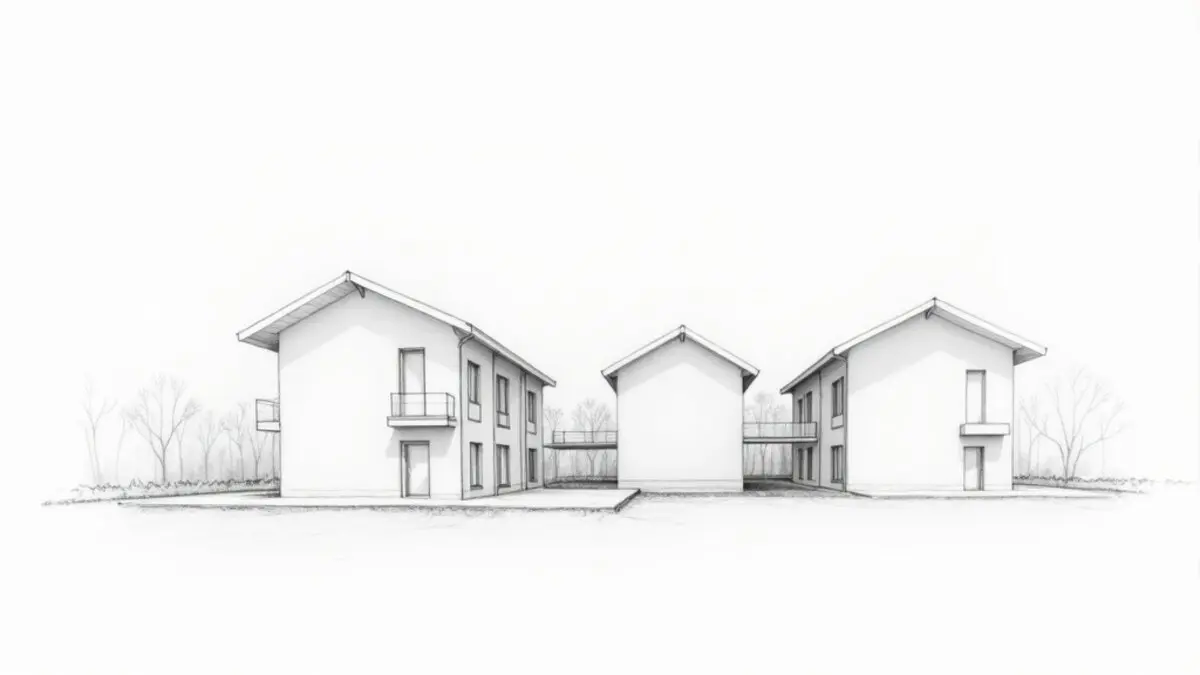
Mr and Mrs X are owners of a house in Villeneuve-d'Ascq, in the Château district. Their land adjoins that of their neighbours, the Y couple, for over thirty years. The two houses are party-wall houses: they share a common wall. But a dispute arises when Mr X decides to build an extension, and the Y couple contest its location, claiming it encroaches on their property.
To settle the matter, Mr X sues the Y couple for a boundary survey before the Tribunal de Grande Instance of Lille. He requests that a surveyor officially delimit the two plots. The Y couple resist: according to them, a boundary survey is impossible because the buildings touch, and the boundary is already fixed by the party wall. Moreover, they invoke acquisitive prescription: they have peacefully possessed the disputed plot for over thirty years.
The court rules in favour of the Y couple on the built part: no boundary survey possible. But it orders a boundary survey on the garden part, where the constructions do not obstruct. Mr X appeals, then appeals to the Court of Cassation. He argues that a boundary survey should be possible even for the constructions, because it was precisely their construction that motivated the action. The Court of Cassation dismisses his appeal by a judgment of 25 June 1970.
The court's reasoning — dissected
The Court of Cassation, in its judgment, lays down a simple but fundamental principle: the action for boundary survey (provided for in Article 646 of the Civil Code) ceases to be exercisable when it concerns buildings that touch. Why? Because the purpose of a boundary survey is to fix an uncertain boundary between two plots of land. However, when constructions are bounded by their walls, the boundary is already materialised and certain. In other words, what is already delimited by the construction itself cannot be surveyed.
The judges add that, on the built part, acquisitive prescription (Articles 2258 et seq. of the Civil Code) may apply. In short, if an owner has possessed land continuously, peacefully, publicly and unequivocally for thirty years, they may become owner without a title. Here, the Y couple had possessed the disputed strip for over thirty years, so prescription was acquired.
Note however: the decision does not completely close the door to boundary surveys. It specifies that the action remains possible for unbuilt parts, such as gardens. What few people know is that this case law has been constant since 1970. It has been confirmed several times, notably by a judgment of the Third Civil Chamber of 9 November 1983 (No. 82-13.674).
What this means for you — practically
If you are the owner of a party-wall house or a contiguous building, this decision directly concerns you. Imagine you live in Wasquehal, in a street where houses are attached. Your neighbour builds a conservatory that, in your opinion, encroaches on your land. You want a boundary survey to assert your rights. Bad news: if the buildings already touch, the judge may refuse a boundary survey for the built part.
But this is not inevitable. undefined, I have come across cases where a boundary survey was possible for the gardens, even if the houses were party-wall. For example, an owner in Villeneuve-d'Ascq obtained a boundary survey on his garden plot, which clarified rights of way and avoided a more serious conflict.
For a buyer, caution: before buying a party-wall house, check whether a boundary survey has already been done or is possible. If the buildings touch, a boundary survey will be impossible for the built part. You will have to rely on title deeds (notarial acts) and cadastral plans (tax documents). In case of doubt, call in a surveyor for a condition survey.
Four tips to avoid this type of dispute
- Carry out an amicable boundary survey before any construction: even if the buildings touch, a surveyor can delimit the unbuilt parts. This avoids nasty surprises. Budget between €1,500 and €3,000 for an amicable boundary survey, a modest investment compared to the cost of a trial.
- Check the title deeds and the cadastre: before buying, ask the notary to compare the deeds and the cadastral plan. If inconsistencies appear, a boundary survey is necessary before the sale.
- Do not wait thirty years to act: if you notice an encroachment (construction on your land), react quickly. The thirty-year acquisitive prescription can deprive you of your rights. A simple registered letter with acknowledgement of receipt to your neighbour may suffice to interrupt prescription.
- Prefer an amicable solution: before going to court, try mediation or conciliation. An agreement signed before a notary is faster and cheaper than a trial. Many boundary survey disputes are resolved amicably.
Further reading: related case law and developments
The 1970 decision is part of a consistent line. Already, a Court of Cassation judgment of 8 March 1965 (No. 63-12.345) had held that a boundary survey is impossible when the plots are separated by a party wall. More recently, the Third Civil Chamber reiterated this principle in a judgment of 12 July 2018 (No. 17-22.456): 'the action for boundary survey is not admissible when the plots are separated by a construction'. The trend is therefore clear: judges are strict on the impossibility of a boundary survey in the presence of contiguous buildings.
But caution: this rule has exceptions. If the wall is not party but private, a boundary survey may be possible to determine the ground boundary. Similarly, if the constructions do not physically touch (for example, a gap of a few centimetres), a boundary survey remains possible. In doubt, consult a lawyer lawyer.
In practice: what to do
FAQ:
- Can I request a boundary survey if my house touches the neighbour's? No, for the built part. But you can request it for the garden or courtyard.
- What if my neighbour builds on my land? Have the encroachment recorded by a bailiff (bailiff's report, about €200) and send a formal notice. If a boundary survey is impossible, you can bring an action for recovery of property (petitory action).
- What is the time limit to act? The action for boundary survey is imprescriptible (no time limit), but acquisitive prescription may apply after 30 years. Act as soon as you become aware of the encroachment.
- How much does a judicial boundary survey cost? Budget between €3,000 and €8,000, depending on complexity. An amicable boundary survey is cheaper (€1,500 to €3,000).
Are you in a similar situation? A first 30-minute consultation with Maître Zakine (€45) can save you months of proceedings — and often much more. Book an appointment →
📌 Does this apply to your situation? Maître Cécile Zakine, French real estate lawyer, practises throughout France.
servitude-droit-passage-avocat/" rel="dofollow">→ Avocat servitudes & foncier |
→ Browse all our legal articles
