Leading case: cc • No. 94-80.962 • 1994-11-09 • View the decision →
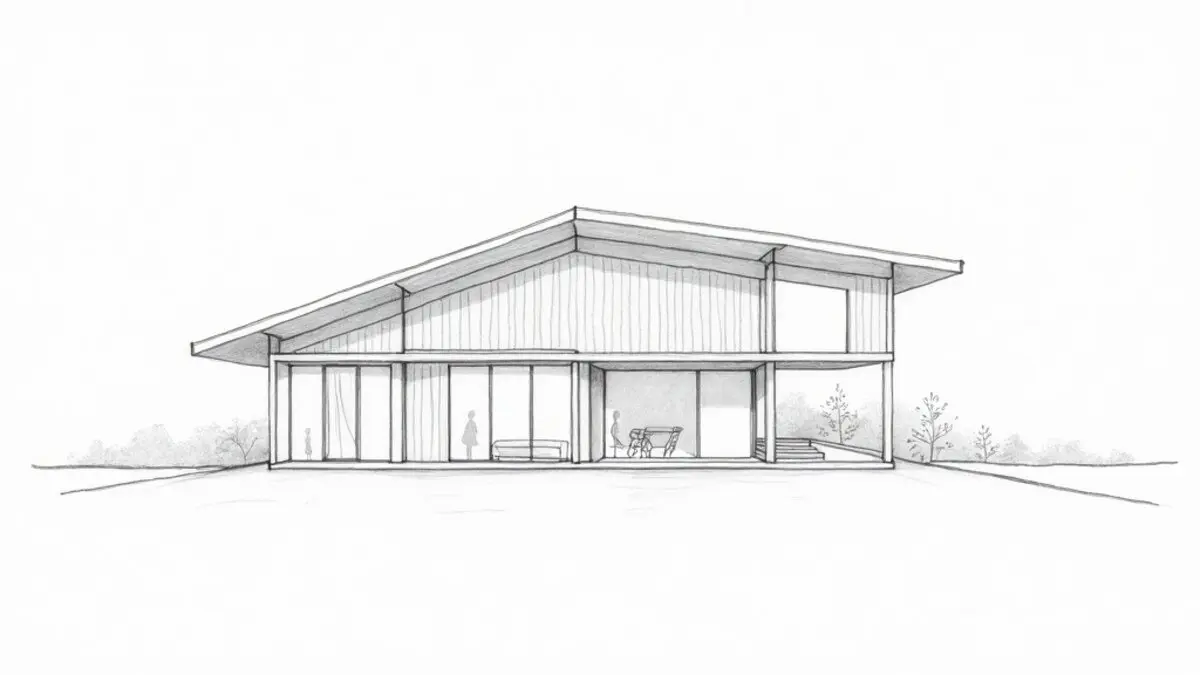
Imagine: you own a large house in Albertville, with a beautiful garden. To supplement your income, you decide to divide the interior into three self-contained studios. The works are simple: partitioning, installation of kitchenettes, individual meters. Nothing changes externally, neither the roof nor the windows. But then a disgruntled neighbour reports you to the town hall, which demands planning permission and threatens you with a fine. Are you acting illegally? This is the question answered by the French Court of Cassation in a judgment of 9 November 1994, which is still applicable today.
Many property owners think that as soon as you touch the structure or increase the number of dwellings, permission is mandatory. However, the distinction is more subtle: what matters is the concept of change of use and alteration of the external appearance. In this judgment, the High Court clarified that internal fitting-out works, even if they turn a single-family house into several studios, are not subject to planning permission provided they do not change the use of the building (which remains residential) and do not alter its external appearance.
But caution: this freedom has limits. The judges recalled that these works must comply with the rules of the local land use plan (POS, now PLU). If they contravene these rules – for example, if the PLU prohibits division into multiple dwellings in that area – they constitute an offence. In other words, no permission, but no lawlessness either. Let us decipher this decision and its practical consequences for property owners, particularly in Aix-les-Bains or Chambéry.
The Facts: An Everyday Story
Mr Philippe, owner of a house in Paris, decides to convert his home into several studios. He carries out internal fitting-out works: creation of partitions, installation of separate sanitary facilities and kitchens, installation of individual electricity meters. Externally, nothing changes: the façade, roof, and openings remain identical. The house continues to be used for residential purposes, but now accommodates several households instead of one.
The problem arises when the town hall finds that the studios do not comply with certain requirements of the local land use plan (POS). It prosecutes Mr Philippe for infringement of Articles L. 160-1 and L. 480-4 of the French Planning Code (now L. 421-1 et seq.). The criminal court convicts him. Mr Philippe appeals, and the Paris Court of Appeal upholds the conviction on 24 January 1994. He then appeals to the Court of Cassation.
Before the Court of Cassation, Mr Philippe argues that the works carried out did not require planning permission, as they neither altered the external appearance nor changed the use of the building. He therefore contests any offence. The central legal question is: are internal fitting-out works that do not change the use of a residential building subject to planning permission? And, if not, can they nevertheless constitute an offence against substantive planning rules?
The Reasoning of the Court — Analysed
The Court of Cassation, in its judgment of 9 November 1994, partially quashes the appeal judgment. It first recalls the principle: under Article L. 421-1 of the Planning Code (now Article R. 421-14 et seq.), works that do not have the effect of altering the external appearance of a building or creating additional storeys, and that do not change its use, may be undertaken without authorisation. In other words, if you divide your house into studios without touching the façade and without creating new floors, you do not need planning permission.
However, the Court immediately states a crucial limit: these works, although exempt from permission, must comply with the requirements of the local land use plan (POS) or local urban development plan (PLU). If the POS prohibits, for example, the creation of several dwellings in a suburban area, then the works are illegal and constitute an offence under Articles L. 160-1 and L. 480-4 of the Planning Code. The Court of Appeal had not verified this point: it had convicted Mr Philippe without demonstrating that the works actually contravened the POS. The Court of Cassation therefore quashes the conviction on this head but refers the case back for the trial judges to examine the compatibility of the works with the POS.
What few people know is that this judgment distinguishes two things: on the one hand, the need for planning authorisation (planning permission); on the other, compliance with the substantive rules of the planning document. You may be exempt from permission, but you must still comply with the PLU. In short, the freedom to carry out internal alterations is not absolute. undefined, I have come across cases where owners in Aix-les-Bains divided their villa into four studios without permission, thinking they were safe, but the local PLU limited the number of dwellings per plot. Result: a fine and an obligation to restore the property to its original state. In other words, before taking out the jackhammer, check your PLU!
What This Means for You — Practically
For the landlord owner: You can divide your house into studios without permission if you stay within the existing volume and do not alter the external appearance. But you must consult the PLU of your municipality. For example, if you are in Chambéry, check the zone regulations. If the PLU allows multiple dwellings, you are safe. Otherwise, you risk a fine of €1,200 to €300,000 (depending on the severity) and an obligation to restore compliance. Also consider the condominium regulations if you are in a condominium: they may prohibit division.
For the tenant: If you rent a studio resulting from a division, ensure that the dwelling is decent and that the owner has complied with the rules. An owner who divides without authorisation may be required to carry out works, which could disrupt your peace. If in doubt, ask the town hall about the legality of the division.
For the buyer: Before purchasing a house that has already been divided, ask the seller to provide a certificate of non-objection or a planning certificate. If works were carried out without permission, you could be held jointly liable for the offences. A concrete example: in Aix-les-Bains, a house sold as a "buy-to-let investment" with three studios turned out to be non-compliant with the PLU. The buyer had to incur restoration costs of €15,000.
For the co-owner: If you are in a condominium, any division may require approval from the general meeting. Even if the works do not alter the exterior, they may increase service charges or modify the co-ownership shares. Plan ahead.
Four Tips to Avoid This Type of Dispute
- Consult the PLU before any project: Go to the town hall or visit your municipality's website to check the rules applicable to your plot. Some zones prohibit the creation of multiple dwellings, others impose a minimum number of parking spaces.
- Apply for a planning certificate: This free document (unless it is an operational certificate) tells you whether your project is compliant. It protects you in case of subsequent inspection.
- Use an architect or surveyor: A professional can help you design a project that complies with the rules and, if necessary, file a preliminary declaration. Even if you think you are exempt, it is better to be safe.
- Do not neglect the condominium regulations: If you live in a condominium, read the regulations. They may impose restrictions on divisions or lettings. A breach can lead to neighbour disputes and legal costs.
Further Reading: Related Case Law and Developments
This 1994 judgment is part of a consistent line of the Court of Cassation. We can cite a judgment of 20 January 1993 (No. 91-84.184) which had already held that the conversion of a house into several dwellings without external alteration does not require permission. On the other hand, a judgment of the same year (8 June 1994) convicted an owner for creating an opening in the façade without authorisation, illustrating the limit of external appearance.
Since then, the ALUR law of 2014 has strengthened declaration requirements for divisions, but the principle remains the same: no permission if no external alteration or change of use. The courts continue to apply this distinction, but they are increasingly strict on compliance with the PLU. The current trend is to protect suburban areas from excessive densification. Thus, even without permission, a division may be annulled if it alters the character of the neighbourhood.
Frequently Asked Questions
- Can I divide my house into studios without permission? Yes, if you do not alter the exterior and the house remains used for residential purposes. But you must comply with the PLU and, where applicable, the condominium regulations.
- What should I do if my neighbour divides their house and it bothers me? You can check the PLU to see if it is permitted. If not, report it to the town hall, which can take enforcement action. You can also bring a claim for abnormal neighbourhood disturbance.
- What are the risks if I divide without authorisation? You face a fine (up to €300,000 for legal persons), an obligation to restore the property (demolition), and damages. The limitation period for the offence is 6 years.
- Do I have to declare the new dwellings to the town hall? Yes, even without permission, the creation of new dwellings must be declared for income tax purposes (change of cadastral category). Fill in form Cerfa No. 6650.
- Can I divide a flat in a condominium? This is more complex because the condominium regulations may prohibit division. Even if they allow it, you must obtain approval from the general meeting and comply with planning rules.
Are you in a similar situation? A first 30-minute consultation with Maître Zakine (€45) could save you months of proceedings — and often more. Book an appointment →
📌 Does this apply to your situation? Maître Cécile Zakine, French real estate lawyer, practises throughout France.
servitude-droit-passage-avocat/" rel="dofollow">→ Avocat servitudes & foncier |
→ Browse all our legal articles
