Reference Decision: cc • No. 12-18.844 • 2013-11-06 • View the decision →
Imagine: you have just acquired a plot of land in Tarbes, trusting the plans provided by your architect. You sign a contract with a contractor to build your villa with a swimming pool. But a few months after delivery, a neighbour informs you that your construction exceeds the height allowed by the planning permission. Who is liable? The architect? The contractor? Yourself?
This is precisely the question that the Court of Cassation decided in a judgment of 6 November 2013 (No. 12-18.844). And the answer is clear: in the absence of a project manager and precise layout plans, the contractor has an obligation to verify the conformity of the construction with the planning permission and planning regulations. In other words, he cannot hide behind the plans provided to him without checking them.
This decision, handed down by the Third Civil Chamber, is a reminder for all building professionals. But it also interests owners, landlords and purchasers: it sets out the responsibilities of each party in the event of non-compliance. So, what should we remember? And how can we avoid finding ourselves in a similar situation?
The Facts: A Story Like Many Others
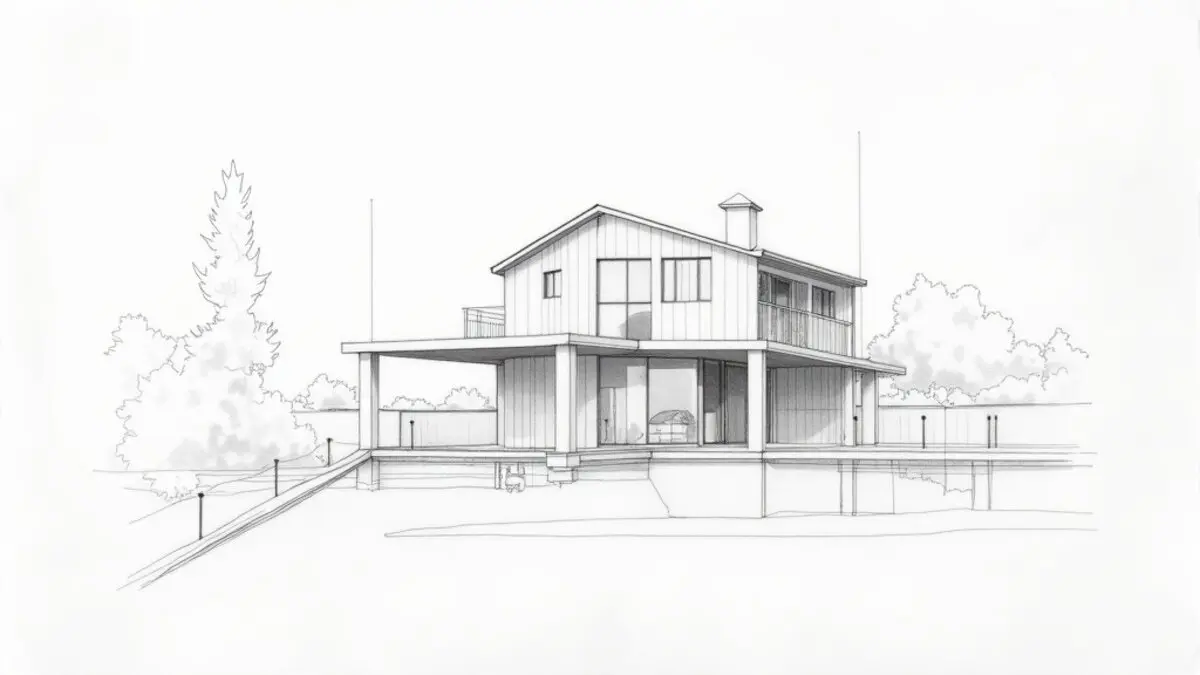
Mr X, an owner in Tarbes, wished to have a villa with a swimming pool built. He entrusted the preparation of the planning permission plans to the Firon architecture firm. These plans were submitted and planning permission was granted on 21 November 2005. But attention: the planning permission plans are not detailed execution plans. They are purely indicative documents intended for the administration, setting out the main lines (layout, height, surface area, etc.).
Mr X then signed a contract with a contractor to carry out the works. No project manager was appointed to coordinate the site. The contractor therefore worked directly under the direction of the owner. However, when building, the contractor did not rely on precise layout plans (those that indicate exactly where to place walls and pipes). He merely followed the planning permission plans, which he adapted to the land.
Result: the construction did not comply with the planning permission! The neighbour sued Mr X and the contractor to obtain demolition of the non-compliant structures. The owner then brought a claim against the contractor for an indemnity, considering that it was up to him to verify compliance.
The Pau Court of Appeal ruled in favour of the owner, ordering the contractor to compensate him. The contractor appealed to the Court of Cassation, but the Court of Cassation dismissed his appeal. It confirmed that the contractor, in the absence of a project manager and layout plans, had an obligation to verify the conformity of the construction with the planning permission. He could not simply follow the planning permission plans without checking them.
The Reasoning of the Court — Analysed
To understand this decision, we must first know the legal basis used. The Court of Cassation relies on Article 1240 of the Civil Code (formerly 1382), which provides that "any act of a person which causes damage to another obliges the person by whose fault it occurred to repair it". In short, if the contractor commits a fault, he must compensate the owner for the loss suffered.
But what is the contractor's fault? The Court considers that, even without a project manager, the contractor is a construction professional. As such, he has a duty to advise and be vigilant. He must ensure that the works he carries out comply with the planning permission and planning rules. If he does not have detailed layout plans, he must ask the owner to provide them or, failing that, prepare them himself.
However, note: the Court does not say that the contractor is always liable for everything. It specifies that this obligation arises "in the absence of a project manager and layout plans". If a project manager (architect, design office) is present, it is he who assumes the primary responsibility for compliance. But if the owner directly engages a contractor without going through a project manager, the latter then assumes an increased share of liability.
What few people know is that this decision is not isolated. It forms part of a consistent line of case law from the Court of Cassation that reinforces the liability of builders. The judges consider that a professional cannot hide behind ignorance of planning rules: he must know them, or at least verify them.
In this case, the contractor committed a fault by not verifying the conformity of his layout with the planning permission. He was therefore ordered to compensate the owner for the costs of demolition and reconstruction, as well as for loss of enjoyment.
What This Changes for You — Practically
This decision has very practical implications for several profiles:
Owner building without an architect: If you are in this situation, you must imperatively provide the contractor with detailed layout plans or require him to prepare them. Keep a written record of all instructions. In case of non-compliance, you can claim against the contractor if he did not verify the planning permission. But be careful: if you yourself give instructions contrary to the planning permission, your liability will be engaged.
Purchaser of a non-compliant property: Imagine you buy a villa in Biarritz and discover after the sale that it does not comply with the planning permission. You can take action against the seller (for latent defect) and, if the works are recent, against the contractor on the basis of contractual liability. But time limits are short: generally, you have 5 years from the completion of the works to act against the builder.
Tenant: If you rent a non-compliant property, you are not directly liable. But you may suffer consequences if the town hall orders demolition or remedial work. Check that the property has a valid planning permission before signing the lease. In case of a problem, you can request a rent reduction or terminate the lease without penalty.
undefined, I have come across cases where owners had to pay several tens of thousands of euros to demolish and rebuild a non-compliant extension. Without this case law, the contractor could have exonerated himself from all liability. Today, the balance tips in favour of the owner.
Four Tips to Avoid This Type of Dispute
- Hire a qualified project manager: An architect or a technical design office (BET) will prepare precise execution plans and assume responsibility for compliance with the planning permission. Your peace of mind has a cost, but it is much lower than that of a dispute.
- Require detailed layout plans: Before the start of works, ensure that the contractor has dimensioned plans indicating distances, heights and boundaries. These plans must be validated by a professional and approved by the town hall if necessary.
- Check the planning permission yourself: Even without being an expert, compare the works carried out with the indications of the planning permission. If you see a difference, stop the site and seek advice from a lawyer specialising in property law.
- Have a completion certificate drawn up: At the end of the works, sign a completion certificate with the contractor. Mention any reservations regarding compliance. This document serves as evidence and protects you in the event of a subsequent dispute.
Besoin d'un conseil personnalisé ? Contactez Maître Zakine — première consultation 30 min à 45€.
Further Reading: Related Case Law and Developments
The decision of 6 November 2013 confirms a trend already initiated by the Court of Cassation. For example, in a judgment of 19 June 2013 (No. 12-14.540), the Court had already held that the contractor must verify compliance with the planning permission even in the presence of a project manager, if the latter had not provided execution plans. In other words, the contractor's liability is engaged as soon as he participates in a non-compliant construction, unless he can prove that he received precise instructions and followed them in good faith.
Conversely, some older decisions (such as Cass. 3rd Civ., 7 March 2007, No. 05-19.638) exonerated the contractor when he had executed the plans provided by the project manager without verifying their compliance. The case law has therefore evolved towards greater liability for professionals. This evolution is logical: contractors are lawyers, they must know the basic rules of planning.
For the future, we can expect this obligation to be extended to other parties (subcontractors, material manufacturers) if their involvement in the non-compliant construction is established. It is therefore essential for any professional to compile a complete verification file.
Frequently Asked Questions
Can I hold the contractor liable if I myself validated the plans?
Yes, if the contractor did not draw your attention to an obvious non-compliance. He has a duty to advise and must alert you.
What are the time limits for taking action against the contractor?
You have 5 years from the completion of the works for the decennial liability, and 10 years from the discovery of the damage for ordinary contractual liability.
What should I do if the town hall asks me to demolish?
Contact a lawyer immediately. You can request regularisation if the non-compliance is minor, or bring a claim against the contractor for compensation.
Can the contractor claim against the owner?
Yes, if the owner provided him with erroneous plans or instructions contrary to the planning permission. But the burden of proof is heavy for the contractor.
Do I necessarily need an architect for a small construction?
No, for constructions under 150 m², an architect is not mandatory. But it is strongly recommended to avoid disputes.
Are you in a similar situation? A first 30-minute consultation with Maître Zakine (€45) may save you months of litigation — and often much more. Book an appointment →
📌 Does this apply to your situation? Maître Cécile Zakine, French real estate lawyer, practises throughout France.
servitude-droit-passage-avocat/" rel="dofollow">→ Avocat servitudes & foncier |
→ Browse all our legal articles
