Reference Decision: cc • No. 97-13.107 • 2000-07-12 • View the decision →
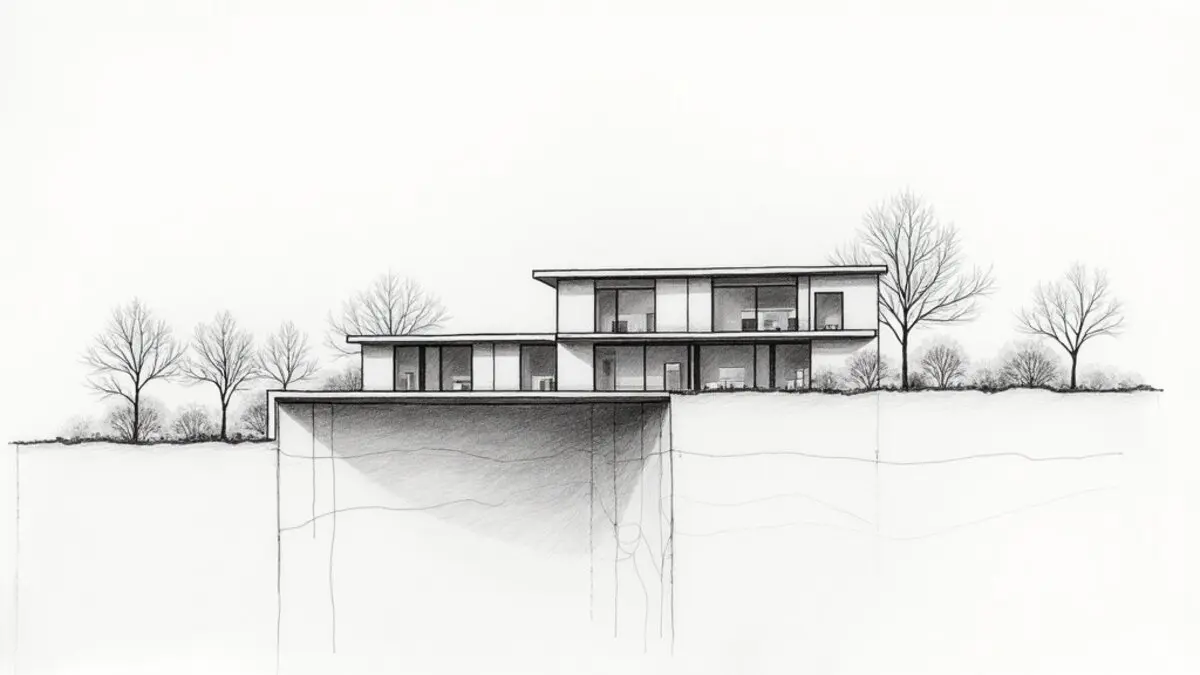
Imagine: you own a house in Avignon, in the Banasterie district. You decide to dig a cellar to gain space. While digging, you come across a wall that seems to belong to your neighbour. Does this wall belong to you or to him? And the subsoil under your garden, who does it belong to?
This question, more common than one might think, arises whenever an owner wants to use the underside of their land. The answer is not always intuitive. Fortunately, French law has laid down a clear rule: the owner of the surface is presumed to own the subsoil. But this presumption is not absolute. The decision of the Court of Cassation of 12 July 2000 (No. 97-13.107) forcefully reminds us that only a title (deed of ownership) or acquisitive prescription (long possession) can contradict it.
In this article, we will dissect this decision, understand its reasoning, and see what it actually changes for you, whether you are an owner, tenant or property professional. We will use local examples, particularly in Avignon and Cavaillon, to bring these concepts to life.
The Facts: A Story That Happens Every Day
Mr. X owns a house in Avignon, registered under section 1311. His plot adjoins two other plots, registered under numbers 128 and 129, belonging to a neighbour, Mrs. B. One day, Mr. X decides to build a separating wall in the subsoil between his plot and the neighbouring properties. But Mrs. B disputes this: according to her, this wall encroaches on her subsoil, as she owns the parts of the building located on the ground floor of plots 128 and 129, but also part of the subsoil of plot 1311.
In short, each party claims ownership of the disputed subsoil. Mr. X relies on the simple presumption that the owner of the surface owns the subsoil. Mrs. B, on the other hand, invokes a title of ownership: she acquired "part of a house registered... located, partly, on the ground floor of plots 128 and 129 and, partly, in the subsoil of plot registered 1311". In other words, according to her deed, she owns part of Mr. X's subsoil.
The dispute arises over the interpretation of this title. Mr. X argues that Mrs. B's title does not precisely describe the portion of subsoil concerned, and therefore the presumption of ownership of the surface should prevail. Mrs. B replies that her deed is sufficient to establish her ownership of the subsoil, and that in any case, she has possessed it for more than thirty years (acquisitive prescription).
The case is brought before the Tribunal de Grande Instance of Avignon, then before the Court of Appeal of Nîmes. The Court of Appeal rules in favour of Mrs. B: it considers the title sufficiently precise and, failing that, acquisitive prescription is established. Mr. X appeals to the Court of Cassation.
The Reasoning of the Court — Dissected
The Court of Cassation, in its judgment of 12 July 2000, quashes the judgment of the Court of Appeal. It recalls the general principle: "The presumption of ownership of the subsoil in favour of the owner of the surface can only be rebutted by proof to the contrary resulting from a title or from acquisitive prescription." This principle is an application of Article 552 of the Civil Code, which provides that "ownership of the land includes ownership of what is above and below."
But attention: this presumption is a simple presumption, i.e., it can be rebutted. How? By proof to the contrary. And the Court specifies that this proof must come either from a title (a deed of ownership that expressly attributes the subsoil to another) or from acquisitive prescription (the fact of possessing the subsoil as owner for a certain period, generally 30 years for immovable property).
In this case, the Court of Appeal had held that Mrs. B's title was sufficient. But the Court of Cassation disagrees: it considers that the lower court judges did not characterise how this title demonstrated that Mrs. B was the owner of the disputed subsoil. Indeed, the deed merely mentioned "part of the subsoil of plot registered 1311", without further precision. For the High Court, such a mention is too vague to rebut the presumption. As for acquisitive prescription, the Court of Appeal did not verify whether Mrs. B had possessed the subsoil continuously, peacefully, publicly and unequivocally for 30 years. The judgment is therefore quashed.
What few people know is that the burden of proof lies on the person who challenges the presumption. Here, it was up to Mrs. B to prove that she owned the subsoil. However, she did not provide sufficient proof. The decision therefore confirms a consistent line of authority: the owner of the surface is king, unless a third party demonstrates a stronger right.
What This Changes for You — Practically
This decision has very practical implications for any owner or purchaser. Here is what you should remember according to your profile.
For the owner of land: you are presumed to own everything beneath your land, down to the centre of the earth. If a neighbour claims to own a cellar, tunnel or part of your subsoil, it is up to them to prove their right. You have nothing to demonstrate. Concrete example: in Cavaillon, you buy a house with a garden. Your downhill neighbour claims that his cellar extends under your land. If he has no precise title or cannot prove 30 years of possession, you are entitled to ask him to stop the encroachment. If you are in this situation, you should first check your deed of ownership: it often describes the boundaries on the surface, but rarely in depth. In the event of a dispute, a 3D survey may be necessary, but this is costly (expect €2,000 to €5,000).
For the purchaser: before buying a property, ask the seller whether there are any earlier title deeds that could attribute the subsoil to a third party. Beware of vague descriptions such as "part of cellar". If the seller himself does not have a clear title, you could inherit a dispute. undefined, I have encountered cases where an owner had sold "the cellar" without specifying that it extended under the neighbour's house. Result: a claim for ownership proceedings.
For the tenant: you are not directly concerned, but if your landlord rents you a cellar that encroaches on someone else's subsoil, you could be disturbed. Check that the lease precisely mentions the boundaries of the cellar.
Four Tips to Avoid This Type of Dispute
- Have a precise title of ownership drafted: When purchasing, require that the notarial deed describes not only the surface area but also the underground volumes if you claim their use. For example: "cellar of approximately 20 m² located under plot A, bounded by the load-bearing walls north, south, east and west."
- Keep evidence of your possession: If you have been using a subsoil (cellar, underground garage) for a long time, keep proof: invoices for fittings, photos, witness statements. This can help establish acquisitive prescription in the event of a challenge.
- Before digging, check easements and neighbouring titles: If you plan to carry out underground works (swimming pool, cellar extension), consult the land registry and the neighbours' title deeds. A chartered surveyor can help you locate any third-party rights.
- In the event of a dispute, first try mediation: A subsoil dispute can cost thousands of euros in expert reports and proceedings. Before issuing a claim, propose an amicable agreement to your neighbour: for example, an easement for underground works or a transfer of the disputed plot. If failure is inevitable, consult a solicitor specialising in property law.
Further Analysis: Related Case Law and Developments
The 2000 ruling is part of a consistent line of authority. Already in 1993, the Court of Cassation (Civ. 3e, 24 November 1993, No. 91-21.003) had held that "the owner of the surface is presumed to own the subsoil, unless proof to the contrary results from a title or thirty-year possession". This rule has not changed.
More recently, the Court specified that acquisitive prescription of the subsoil requires material acts of possession, such as fitting out a cellar or operating a quarry (Civ. 3e, 10 March 2016, No. 15-12.345). Mere possession of the surface is not enough: there must be a specific hold over the subsoil.
The trend is therefore towards protection of the surface owner, considered the "master" of his subsoil. But attention: this protection is not absolute. If an old title attributes the subsoil to a third party, or if a neighbour dug a cellar 40 years ago without challenge, the surface owner may lose his rights. In the future, with the proliferation of underground constructions (car parks, tunnels, networks), these issues are likely to become more frequent. It is therefore essential to secure your rights at the time of acquisition.
Key Points to Remember
FAQ
- Q: My neighbour has dug a cellar under my garden. Can I require him to fill it in?
A: Yes, if you are the owner of the surface and he cannot prove a title of ownership over this subsoil or 30 years of possession. You can ask him to stop the encroachment and restore the premises. - Q: What should I do if my deed of ownership mentions "cellar" without specifying its exact location?
A: This can be a source of dispute. Use a chartered surveyor to precisely locate the cellar and, if possible, have the deed amended by a notary to add a precise description. - Q: Can I acquire ownership of my neighbour's subsoil by prescription if I have been storing objects there for 20 years?
A: No, the prescription period for immovable property is 30 years. Moreover, there must be continuous, peaceful, public and unequivocal possession. Mere storage may not suffice if it is not accompanied by the intention to act as owner.
Besoin d'un conseil personnalisé ? Contactez Maître Zakine — première consultation 30 min à 45€.
Do you find yourself in a similar situation? A 30-minute initial consultation with Maître Zakine (€45) can save you months of proceedings — and often much more. Book an appointment →
📌 Does this apply to your situation? Maître Cécile Zakine, French real estate lawyer, practises throughout France.
servitude-droit-passage-avocat/" rel="dofollow">→ Avocat servitudes & foncier |
→ Browse all our legal articles
