Reference decision: cc • N° 95-16.630 • 1998-01-21 • View the decision →
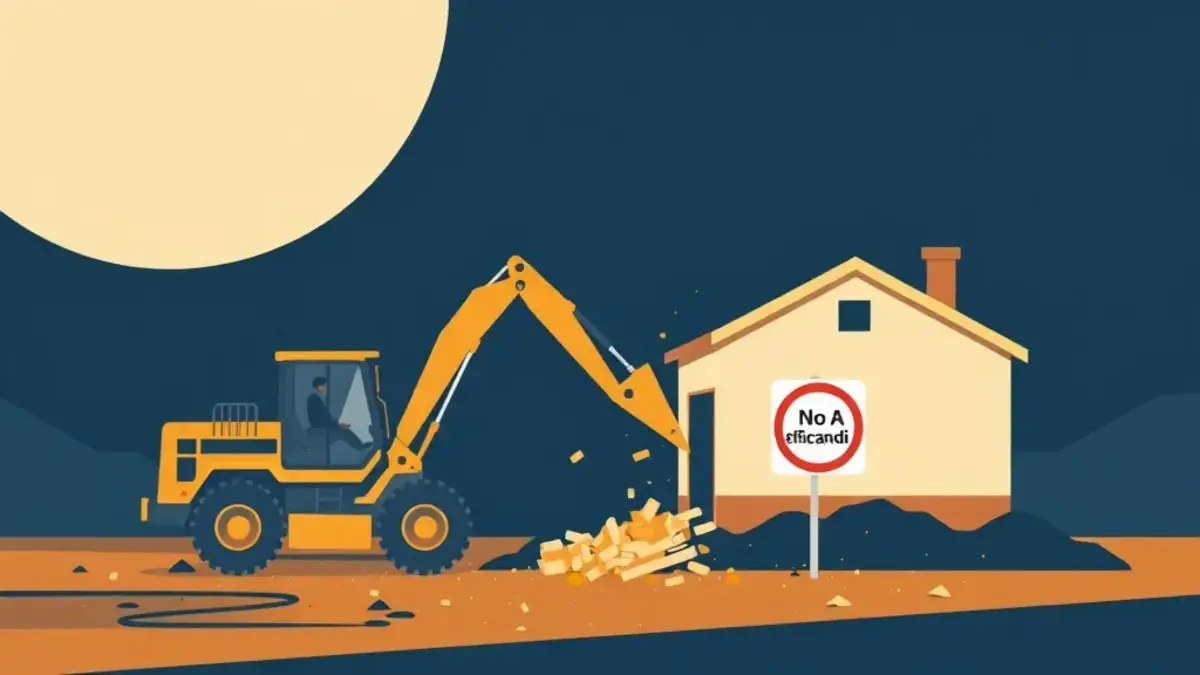
Imagine: you buy a plot of land in Mont-de-Marsan, with an unobstructed view of the arenas, because your neighbour has undertaken by notarial deed never to build. You sign, you move in, you enjoy. And then one morning, construction machinery arrives. Your neighbour builds a wall that blocks your view. You remind him of the easement, he replies: 'Yes, but I never received the agreed consideration, so I consider myself released.' What to do?
This situation was decided by the Cour de cassation on 21 January 1998 (appeal no. 95-16.630). It held: a contractual easement cannot be unilaterally breached on the pretext that the consideration was not provided. The owner who builds in violation of a non aedificandi easement must demolish. Full stop.
But what exactly does this change for you, owner in Capbreton, tenant in Mont-de-Marsan, or co-owner in the Landes? Let us dive into this landmark decision.
The facts: a story like any other
We are in a housing estate called Village de Camarat. The syndicate of co-owners (the association of all owners in the estate) had granted to one of the lots a non aedificandi easement (prohibition to build) over part of the land. In exchange, the owner of that lot was to receive a certain consideration — probably a sum of money or other benefit.
However, the owner of the servient tenement (the one bearing the easement) decided to build anyway, arguing that the promised consideration had never been paid to him. For him, the lack of consideration released him from his obligation not to build. The syndicate of co-owners then took legal action to obtain the demolition of the structures erected.
The court of appeal (the second instance court) ruled in favour of the syndicate, ordering demolition. The owner then lodged an appeal in cassation (a remedy before the highest court). His argument: a contractual easement is a contract; if one party does not perform its obligations (here, paying the consideration), the other party may consider itself released from its own. In other words, 'no consideration, no easement'.
The Cour de cassation rejected this reasoning. It upheld the decision of the court of appeal, holding that it had legally justified its decision. For the High Court, the existence of the easement was not disputed. The fact that the consideration had not been provided did not allow the owner to unilaterally free himself from the easement. He must first obtain a court decision or an amicable resolution of the contract.
The reasoning of the court — broken down
The Cour de cassation relies on the principle that a contractual easement (one created by contract between owners) is a real burden attached to the land, not merely a personal obligation. This means that it 'follows' the land, regardless of who owns it. Article 686 of the Civil Code (which governs easements) provides that easements may be created on properties for the use and benefit of a heritage (a plot of land).
In short, an easement is a real right (a right in rem) and not a personal right (an obligation between persons). Consequently, even if the promised consideration (often an indemnity) has not been paid, the easement remains valid as long as it has not been judicially annulled or modified. The owner cannot take the law into his own hands by building.
The trial judges (the court of appeal) had noted that the existence of the easement was not disputed — the owner acknowledged that it had been created. Therefore, the mere fact of building in violation of this easement constituted a fault (within the meaning of Article 1240 of the Civil Code, formerly 1382, which requires reparation for damage caused by fault). Demolition was the appropriate remedy.
However, be careful: this reasoning does not mean that the consideration is irrelevant. If it has not been paid, the servient owner may take legal action to claim what is due or to seek the termination of the easement (its annulment). But he cannot, on his own authority, decide that it is void. What few people know is that the Cour de cassation has thus protected the stability of easements, which are essential for urban planning and neighbourly relations.
What this changes for you — in practical terms
For the owner benefiting from an easement (the one who has the right to require that the other not build): this decision gives you a powerful weapon. If your neighbour builds in violation of an easement, you can demand demolition, even if you have not paid the agreed consideration. Concrete example: in Capbreton, an owner of a villa with a sea view benefits from a non aedificandi easement over the neighbouring plot. If the neighbour starts to build an extra storey, he can demand demolition without waiting to have paid the agreed indemnity.
For the servient owner (the one bearing the easement): you must respect the prohibition on building, even if you believe that the consideration has not been paid. If you build, you risk demolition at your own expense, not to mention damages. undefined, I have come across cases where owners have had to pay €50,000 for demolition plus €10,000 in damages for erecting a garage in a non aedificandi zone. If you are in this situation, you must either obtain a written agreement from the beneficiary or apply to the court to have the easement declared void before building.
For the purchaser: when buying land, always check for easements in the notarial deed. A non aedificandi easement can significantly reduce the building potential. In Mont-de-Marsan, land with such an easement may lose 30% of its value. Have your notary prepare a statement of easements.
For the co-owner: in a co-ownership, the regulations may contain easements between lots. If a co-owner builds in violation, the syndicate can take action for demolition on the basis of this decision. Time limit: you have 5 years from the construction to act (30-year limitation for real property actions, reduced to 5 years since the 2008 reform).
Four tips to avoid this type of dispute
- Check easements before buying: ask the notary for a list of active and passive easements. Do not rely solely on the seller's declaration. A cadastral extract is not enough.
- Scrupulously respect easements, even if you challenge their validity: if you believe an easement is void or that the consideration has not been paid, do not build before obtaining a court decision or written agreement. Demolition is costly.
- Negotiate a written consideration and perform it: if you create an easement, formalise the consideration in the deed and comply with it. For example, if the easement is granted in exchange for €10,000, pay that sum within the agreed time. Otherwise, the other party may seek termination.
- React quickly if construction violates an easement: if you are the beneficiary, send a formal notice by registered letter as soon as work begins. Apply to the interim relief judge for a suspension of the works. The longer you wait, the more complex and costly the demolition will be.
Besoin d'un conseil personnalisé ? Contactez Maître Zakine — première consultation 30 min à 45€.
Further reading: related case law and developments
This 1998 decision is part of a consistent line. Already in 1993, the Cour de cassation held that violation of a non aedificandi easement justified demolition, even if the construction was completed (Civ. 3e, 10 March 1993, no. 91-13.678). More recently, in 2015, the Court recalled that the judge cannot refuse to order demolition on the ground that the harm is slight (Civ. 3e, 14 October 2015, no. 14-21.030).
The trend is therefore clear: the courts firmly protect contractual easements. They consider that the property right of the beneficiary prevails over the interest of the builder, even if he is in good faith. For the future, it is likely that this strictness will continue, as easements are essential tools for land planning, especially in coastal areas like the Landes.
Key points to remember
- A non aedificandi easement prohibits building. It may be contractual (by contract) or legal (e.g., 3-metre distance from the neighbour).
- You cannot unilaterally free yourself from an easement, even if the promised consideration has not been paid. Only a judge can declare it void.
- Demolition is the standard remedy for violation. The builder bears the costs of demolition and damages.
- Act quickly: 5-year limitation for personal actions, 30 years for real actions (since 2008, reduced to 5 years for easements if the servient owner is in good faith? Caution: the limitation period for the demolition action is 30 years for continuous and apparent easements, but may be reduced to 5 years if the easement is discontinuous or non-apparent. In practice, consult a lawyer.)
- Always check easements before buying or building. A non aedificandi easement can reduce the value of land by 20 to 50%.
Are you in a similar situation? A first 30-minute consultation with Maître Zakine (€45) can save you months of proceedings — and often much more. Book an appointment →
