Reference Decision: cc • No. 77-12.285 • 1978-11-15 • View the decision →
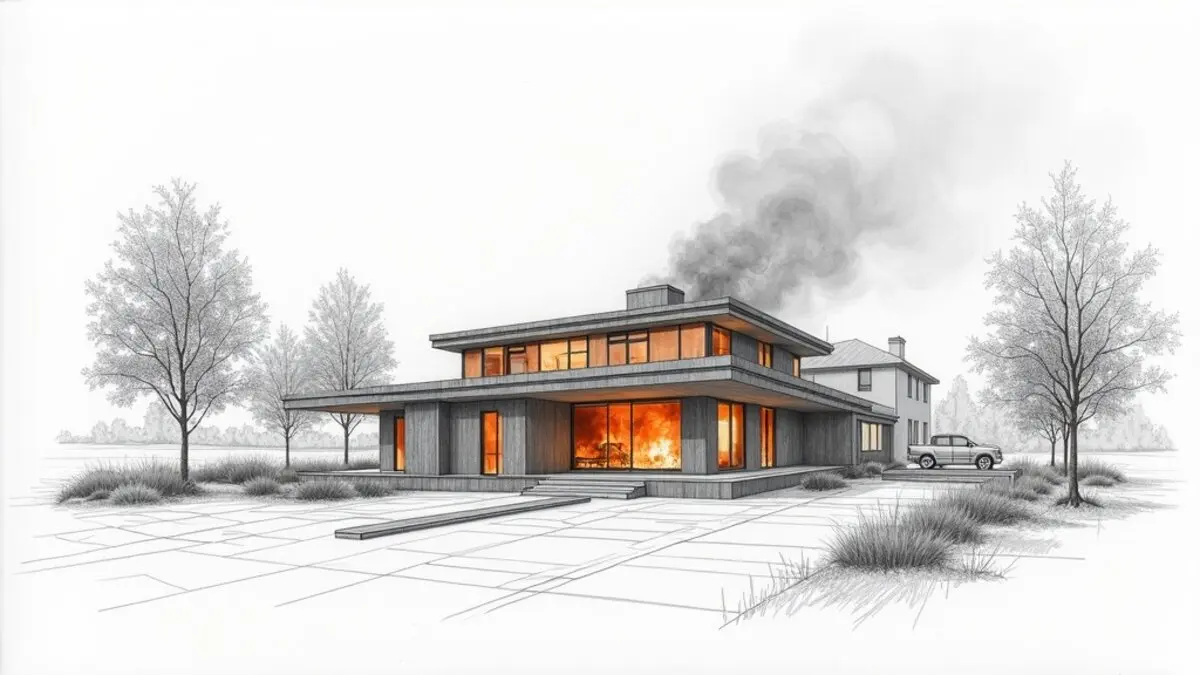
Imagine: you are the owner of a villa with a beautiful garden in Furiani. One summer evening, a fire breaks out at your neighbour’s house. The flames spread to your home. You lose everything. Who do you claim compensation from? The neighbour whose fire started? “Of course,” you think. But the law is not so simple. This 1978 decision of the Court of Cassation establishes an essential rule: to obtain compensation, it is not enough that the fire started from the neighbour’s property. You must prove their fault. A principle which, nearly 50 years later, still governs fire disputes between neighbouring properties.
Why such a requirement? Because the legislature intended to protect the owner whose property is the source of the damage. Fire, often an accidental phenomenon, should not automatically trigger liability. Otherwise, every owner would be bound to pay, even without negligence. The decision we analyse settles a debate: can the concept of neighbourhood disturbance be invoked to circumvent this rule? The answer is no.
What does this decision mean concretely for you, owner or tenant in Corsica, in Bastia, Borgo or elsewhere? It sets the framework for liability in fire cases. It requires you, if you are a victim, to demonstrate that your neighbour committed a fault: negligence, lack of maintenance, an offence. And if you are the source of the fire, it protects you from automatic liability. Full analysis.
The Facts: A Story That Happens Every Day
In 1978, the Court of Cassation examined a case originating from a fire. A married couple, owners of a residential building, saw their property devastated by a fire that started in a neighbouring building. The facts are classic: a fire breaks out at a neighbour’s, spreads, and causes significant damage. The victim sues the owner of the building where the fire started, based on the theory of neighbourhood disturbances. She argues that the mere fact that the fire started from his property constitutes an abnormal neighbourhood disturbance, engaging his liability without needing to prove fault.
The neighbour, for his part, contests. He argues that Article 1384, paragraph 2, of the Civil Code (now codified in Article 1242) provides that the holder of a building in which a fire originated is only liable to third parties in the event of proved fault. He adds that the spread of fire between neighbouring buildings does not fall under the concept of neighbourhood disturbance, which presupposes a continuous and abnormal disturbance, not a single accidental event.
The Court of Appeal ruled in favour of the victim: it condemned the owner on the basis of neighbourhood disturbance. But the owner appealed to the Court of Cassation. The Court of Cassation, in a very short judgment, quashed the appeal decision. It held that “the concept of neighbourhood disturbance cannot be extended to the case of the spread of fire between neighbouring buildings.” In other words, only the special regime of Article 1384, paragraph 2, applies: it is necessary to prove fault on the part of the owner of the source building. A legal twist that sent the parties back to another Court of Appeal, but which established a lasting rule.
The Reasoning of the Court — Analysed
The Court of Cassation relies on Article 1384, paragraph 2, of the Civil Code (now Article 1242 since the 2016 reform). This provision states: “the person who holds, on any basis, all or part of a building or movable property in which a fire originated is only liable to third parties if it is proved that he committed a fault.” The legislature thus established a regime derogating from the common law of liability for things. In principle, the custodian of a thing is liable for damage it causes, even without fault (Article 1242, paragraph 1). But for fire, the legislature intended to protect the holder of the building, because it is often impossible to determine the exact cause of the fire. The victim must therefore prove fault: negligence, lack of maintenance, failure to comply with safety rules.
The central question was: can this rule be circumvented by invoking the theory of neighbourhood disturbances? This theory, based on Article 544 of the Civil Code (right of property), allows a neighbour to obtain compensation when nuisances caused by another owner exceed the normal inconveniences of neighbourhood. It does not require proof of fault: it is enough to demonstrate an abnormal disturbance. If the Court of Appeal had applied this theory, the victim would have succeeded without having to prove the neighbour’s fault.
The Court of Cassation rejects this extension. It considers that the special regime for fire is exclusive: one cannot use another legal basis to avoid the requirement of proved fault. The judges state that “the concept of neighbourhood disturbance cannot be extended to the case of the spread of fire between neighbouring buildings.” This is a landmark decision, confirming the primacy of the special text over the general theory. There is no reversal: the Court confirms a consistent interpretation of Article 1384, paragraph 2.
What This Changes for You — Concretely
If you are an owner or tenant in Borgo, and your house burns due to a fire starting at the neighbour’s, you cannot simply say “it’s his fault, he must pay.” You must prove that he committed a fault: for example, that he left a barbecue unattended, did not maintain his chimney, or stored dangerous flammable products. Without this proof, you cannot obtain compensation from him, unless you turn to your own insurance.
For the owner of the source building, this is valuable protection. Imagine a tenant who forgets a lit candle: the owner cannot be held liable if he has not committed a personal fault. He must simply ensure that his property is in good condition (electrical installation up to standard, smoke detectors…). If he has complied with these obligations, he will not be condemned. On the other hand, if he rented an unhealthy dwelling with a defective installation, his fault will be retained.
A concrete example: in Bastia, a fire starting from a neighbouring garage destroys your garden shed valued at €15,000. You sue the garage owner. If you prove that he stored flammable products without respecting safety rules, you will obtain €15,000. Otherwise, you will have to make do with your insurance indemnity, perhaps with a €500 excess. The difference is significant.
If you are a buyer of a property, check the history of fire incidents in the neighbourhood. Some areas (wooded zones, wasteland) present increased risks. You can negotiate the price or require guarantees.
Four Tips to Avoid This Type of Dispute
- Install smoke detectors: mandatory in all homes, they reduce the risk of fire and constitute proof of your diligence in case of a disaster.
- Maintain your electrical and heating installations: have your electrical panel checked every 10 years and sweep your chimneys at least once a year. Keep maintenance invoices.
- Insure yourself properly: check that your home insurance policy covers damage caused to neighbours (civil liability) and damage suffered (fire). Consider a “legal protection” insurance for litigation costs.
- In case of fire, act quickly: call the fire brigade, secure the premises, take photos, gather testimonies. Declare the disaster to your insurer within 5 working days.
Further Reading: Related Case Law and Developments
This 1978 decision is part of a consistent line. An earlier Court of Cassation decision (Civ. 2e, 19 February 1969) had already established the principle that Article 1384, paragraph 2, is solely applicable in matters of fire, excluding the strict liability of the custodian. More recently, the Court clarified that the fault may be that of an employee or a person for whom one is responsible (Civ. 2e, 10 June 2004, no. 02-18.788). The trend is therefore stable: the legislature intended a protective regime, and judges respect it.
However, a notable development is the rise of insurance. Today, almost all owners are insured against fire. The question of liability is often settled by insurers, who seek recourse against the responsible party if there is fault. The case law therefore remains relevant for cases where insurance does not cover everything (excess, exclusion) or in the absence of insurance.
Key Points to Remember
FAQ:
- Can I obtain compensation without proving my neighbour’s fault if his fire damaged my house? No, unless you invoke your own insurance contract. Vis-à-vis the neighbour, you must prove his fault (negligence, lack of maintenance).
- What should I do if I am a victim of a fire starting at the neighbour’s? Gather evidence: photos, testimonies, fire brigade report. Contact your insurer and, if you consider legal action, consult a lawyer to assess the chances of proving fault.
- What are the time limits to act? The civil liability action is time-barred after 5 years from the day the damage became apparent (Article 2224 of the Civil Code). For insurance, declare the disaster within 5 working days.
- Is the owner always liable for his tenant’s faults? No, unless he himself committed a fault (e.g., defective installation). The tenant is responsible for his own acts.
- Does this rule also apply to forest fires? Yes, if the fire originates on private land. The landowner may be liable if his fault is proved (e.g., prohibited waste burning).
Are you in a similar situation? A first 30-minute consultation with Maître Zakine (€45) can save you months of proceedings — and often much more. Book an appointment →
📌 Does this apply to your situation? Maître Cécile Zakine, French real estate lawyer, practises throughout France.
→ Prendre rendez-vous pour une consultation |
→ Browse all our legal articles
