Reference decision: cc • No. 75-10.808 • 1976-07-06 • View the decision →
Picture the scene: you have just bought a lovely house with a garden in Aubagne, and your new neighbour announces that the dry stone wall separating your two plots belongs entirely to him. He plans to demolish it to enlarge his garage. Have you ever wondered who really owns that wall? This is precisely the question the Court of Cassation decided in 1976, and its answer still sheds light on thousands of neighbour disputes in the Bouches-du-Rhône and elsewhere.
This decision, rendered under number 75-10.808, concerns a dry stone wall surrounding a garden. In law, a boundary wall is presumed to be party (shared between the two owners) in half, unless the contrary is proved. But what happens if one of the owners holds a title (deed of sale, gift, etc.) that clearly states that the wall belongs to them alone? The Court of Cassation answers: this title is sufficient to rebut the legal presumption of party wall status, even if it has not been communicated to the other party.
In clear terms, an owner who can prove by their title that the wall is their exclusive property does not need to provide additional evidence or demonstrate that the neighbour was aware of it. A solution that may seem harsh, but which rests on a fundamental principle: the right of ownership is proved by titles.
The facts: an everyday story
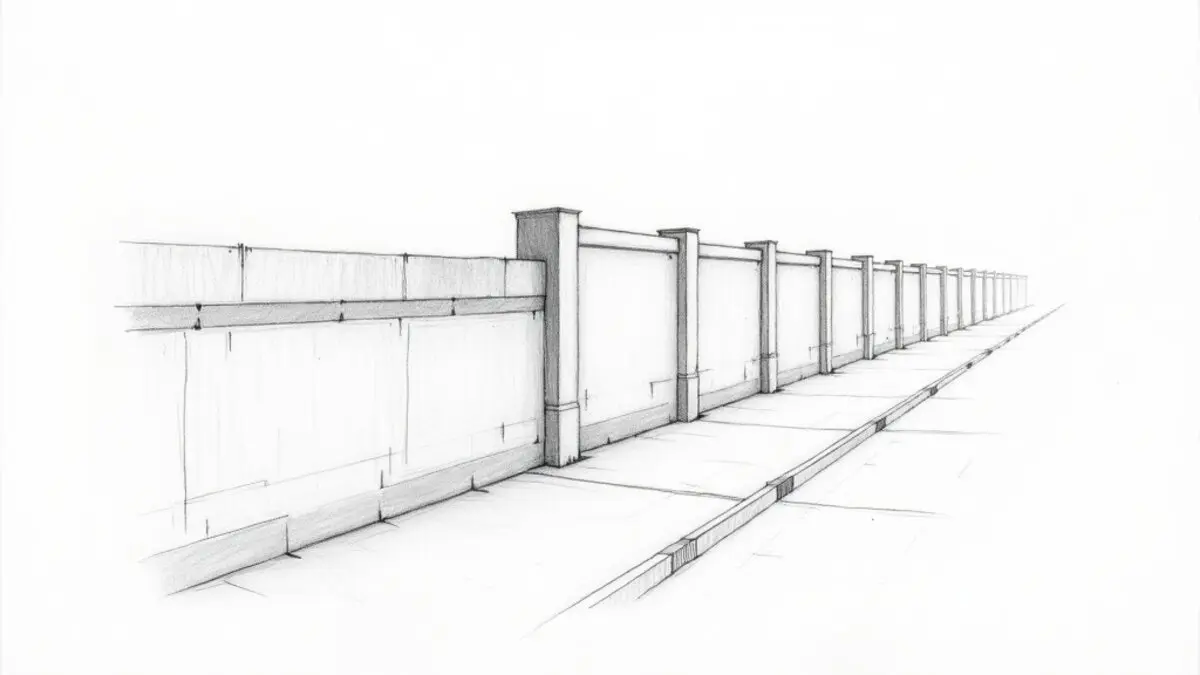
Mr. Dupont, owner of a house in Aubagne for 30 years, and Mr. Martin, his recently arrived neighbour, disagree on the ownership of the dry stone wall bordering Mr. Dupont's garden. This wall, about two metres high, runs along the boundary line for about twenty metres. Mr. Martin, who wishes to install a French window in the party wall, claims that the wall is party and that he can therefore make an opening with his consent. But Mr. Dupont opposes this, asserting that the wall is exclusively his.
The dispute begins with an attempt at conciliation before the Aubagne District Court, which fails. Mr. Martin then sues Mr. Dupont before the Marseille High Court to have the wall declared party and to obtain the right to carry out works on it. In his defence, Mr. Dupont produces his deed of ownership, dated 1972, which expressly states: "the dry stone boundary wall surrounding the garden is the exclusive property of the seller, and the said wall is included in this sale."
The High Court rules in favour of Mr. Martin, holding that the presumption of party wall status is not rebutted by a title that is not common to both parties. Mr. Dupont appeals. The Aix-en-Provence Court of Appeal, in a judgment of 10 December 1974, reverses the decision: it considers that Mr. Dupont's title sufficiently establishes his exclusive ownership, and that the legal presumption of party wall status gives way to this evidence. Mr. Martin appeals to the Court of Cassation.
The reasoning of the court — dissected
The Court of Cassation, in its judgment of 6 July 1976, dismisses Mr. Martin's appeal and upholds the reasoning of the Court of Appeal. It relies on Article 666 of the Civil Code, which provides: "Walls separating buildings up to the eaves, or between courtyards and gardens, and even between enclosures in the fields, are deemed to be party walls, unless there is a title or prescription to the contrary." This text therefore establishes a simple presumption: any boundary wall is presumed to belong in half to each of the two neighbours, unless one of them proves the contrary by a title or by acquisitive prescription (thirty years' possession).
But what is meant by "title"? The Court of Appeal had held that Mr. Dupont's title, although not shared with Mr. Martin, sufficed to establish his exclusive ownership. Mr. Martin argued that Article 666 required proof of ownership enforceable against the neighbour, i.e., a title that was common to him or had been brought to his attention. The Court of Cassation dismisses this argument: it affirms that the title does not need to be common to both parties to rebut the legal presumption. It is enough that the owner who invokes it demonstrates, by a valid deed, that he is the sole owner of the wall.
In other words, proof of exclusive ownership can be provided by any title emanating from the owner himself, even if that title has never been notified to the neighbour. This solution is logical: the right of ownership is an absolute right, and the person who holds it can prove it by documents concerning him. The presumption of party wall status is only a suppletive rule, which yields as soon as contrary evidence is provided.
What few people know is that this decision is part of a consistent line of case law. As early as 1845, the Court of Cassation had held that the title of ownership of only one of the neighbours suffices to establish non-party wall status (Civ., 2 December 1845). The 1976 decision merely reaffirms this principle, clarifying it on the issue of the communicability of the title.
What this changes for you — practically
This decision has important practical implications for owners, buyers and real estate professionals.
For the owner of a boundary wall: if you have a title deed that states that the wall belongs to you exclusively, you can oppose your neighbour carrying out works on it without your permission. You do not have to communicate your title to them beforehand. However, in the event of a dispute, you will have to produce it in court. Concrete example: in Istres, an owner was able to prohibit his neighbour from leaning a garden shed against the party wall, because his 1985 deed of sale specified that the wall was his exclusive property. Result: the neighbour had to demolish the shed at his own expense (estimated cost: €2,500).
For the neighbour who contests: if you think a wall is party, but your neighbour claims the contrary based on his title, you have every interest in asking to see that title. If he refuses, you can apply to the court for an order for its disclosure. But beware: if the title is valid, you risk losing the case and having to pay the costs (lawyer, expert, etc.). It is therefore better to check in advance, for example by consulting the land registry or notarial deeds during a sale.
For the buyer: before buying a property, carefully examine the title deeds and any references to boundary walls. If the seller claims that a particular wall is his exclusive property, make sure this is stated in the deed. Otherwise, the presumption of party wall status will operate in your favour, but you could have surprises with the neighbour.
For the tenant: you are not the owner of the wall, but you may be affected if your landlord becomes involved in a dispute with the neighbour. In that case, you must inform him of any disagreement and let him handle the proceedings.
Four tips to avoid this type of dispute
- Check your title deeds: upon acquiring a property, carefully read the deed of sale to identify any references to boundary walls. If the wall is presented as exclusive, keep this document safe.
- Communicate with your neighbour before any project: before making an opening, raising a wall or leaning a structure against it, inform your neighbour and ask him to show you his titles. A frank discussion can avoid months of proceedings.
- Have a joint inspection report drawn up: if you buy a property, have the notary or a surveyor note the condition of party or non-party walls. This will serve as evidence in the event of a future dispute.
- If in doubt, consult a lawyer lawyer: rather than embarking on proceedings alone, a property lawyer can analyse your titles and advise you on the best strategy. A 30-minute consultation can save you much higher costs.
Besoin d'un conseil personnalisé ? Contactez Maître Zakine — première consultation 30 min à 45€.
Further reading: related case law and developments
The 1976 decision is part of a consistent line of case law. For example, a Court of Cassation judgment of 3 November 1977 (No. 76-10.256) held that the presumption of party wall status can be rebutted by a title even if not communicated, in line with the 1976 decision. More recently, in a judgment of 12 September 2019 (No. 18-18.521), the Court of Cassation reiterated that proof of exclusive ownership of a wall can result from a notarial deed, without needing to prove that the neighbour was aware of it.
The trend of the courts is therefore to protect individual ownership rights, even at the expense of the legal presumption of party wall status. This means that owners must be particularly vigilant in the drafting of their deeds. For the future, we can expect judges to continue to give great probative weight to titles, provided they are clear and precise.
Frequently asked questions
What is party wall status? Party wall status is the legal status of a wall, hedge or ditch that separates two properties and belongs in half to each owner. It is presumed for boundary walls, unless the contrary is proved.
Can I build against a party wall? Yes, but you must comply with certain rules: you must not damage the wall, and you must obtain your neighbour's agreement if you want to lean a structure against it or make an opening.
What if my neighbour claims the wall is his exclusive property? Ask him to provide his title deed. If he refuses, you can apply to the court to have the wall declared party. But if his title is valid, you risk losing the case.
What are the time limits for contesting the ownership of a wall? There is no specific time limit, but acquisitive prescription (peaceful and continuous possession for 30 years) can make a wall party even without a title. If you let your neighbour use the wall as if it were party for 30 years, you could lose your right to object.
How much does a party wall lawsuit cost? Costs vary: lawyer (€1,500 to €5,000), court-appointed expert (€1,000 to €3,000), court fees (several hundred euros). It is better to attempt conciliation or mediation before starting proceedings.
Are you in a similar situation? A first 30-minute consultation with Maître Zakine (€45) can save you months of proceedings — and often much more. Book an appointment →
📌 Does this apply to your situation? Maître Cécile Zakine, French real estate lawyer, practises throughout France.
servitude-droit-passage-avocat/" rel="dofollow">→ Avocat servitudes & foncier |
→ Browse all our legal articles
