Landmark decision: cc • No. 81-90.292 • 1981-11-17 • View the decision →
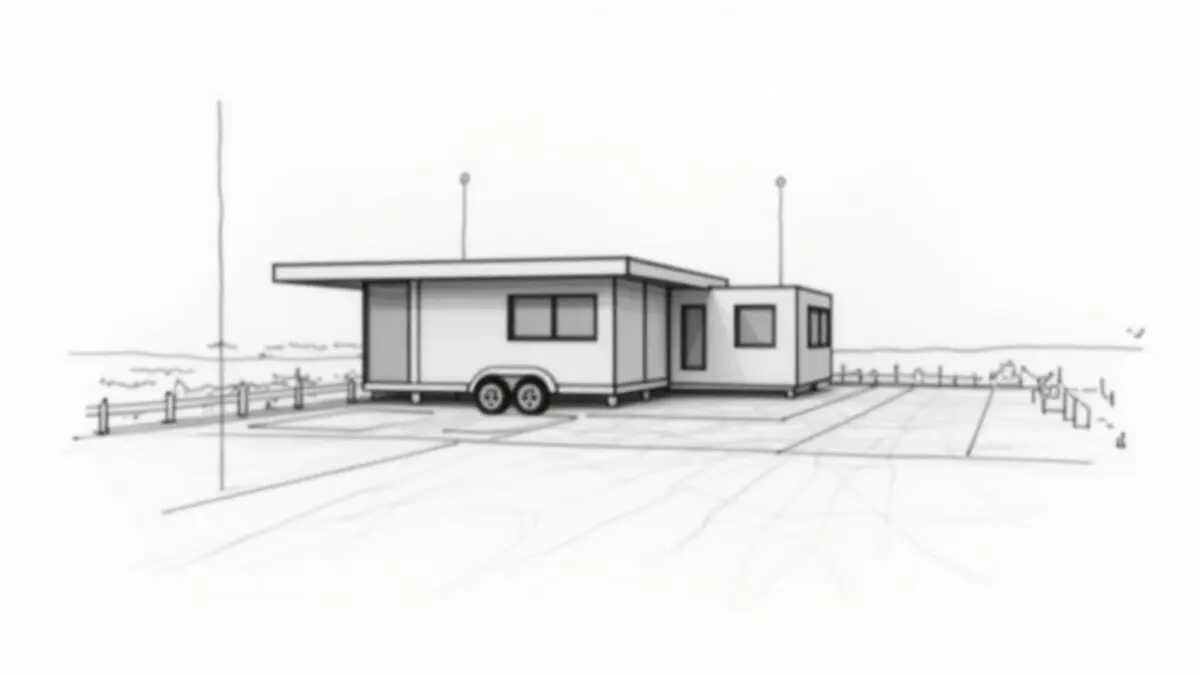
Imagine the scene: in Autun, a landowner installs a caravan on his land. To gain space, he adds prefabricated panels, removable, attached to the caravan and resting on a demountable metal frame. The result? A larger, comfortable living space that looks unmistakably like a small house. The question every landowner asks: do I need planning permission for this? The answer, since 1981, is unequivocal: yes.
What few people know is that this question was settled by the Court of Cassation over forty years ago, in a decision that still carries authority. The case pitted a landowner in Montceau-les-Mines against the administration, which considered the installation constituted construction subject to permission. The Criminal Court of Chalon-sur-Saône convicted the landowner, and the Court of Appeal of Poitiers upheld that decision. The Court of Cassation dismissed the appeal, establishing a clear principle.
But what does this actually change for you today? Whether you are a landowner, a mobile home tenant, or a property professional, this decision affects you. It sets the boundary between what is a simple caravan (regulated by the Town Planning Code, but without permission) and what becomes a construction requiring prior authorisation. undefined, I have come across cases where landowners had to demolish costly improvements for neglecting this rule. So, before adding a veranda to your caravan or erecting a structure around it, read on.
The facts: a story that happens every day
Mr X, owner of a plot in Autun, decides to install a caravan on it. But a simple caravan is not enough: he wants more space. He buys prefabricated panels, attaches them to the caravan, and rests them on a demountable metal frame. The whole forms a construction of about 20 m², with a solid roof and walls. For the administration, this is a 'prefabricated dwelling' that requires planning permission.
The landowner contests: according to him, it is only an improved caravan, and the panels are removable. He invokes the regulations on caravans (Articles R. 443-1 et seq. of the Town Planning Code) which exempt them from permission under certain conditions. But for the judges, the installation is no longer a caravan: it has become a fixed construction, even if it can be dismantled. The Criminal Court of Chalon-sur-Saône convicts him for an offence under the Town Planning Code. He appeals to the Court of Appeal of Poitiers, which upholds the conviction on 8 January 1981.
The landowner appeals to the Court of Cassation. He argues that the panels are removable and that the whole remains a caravan within the meaning of the Town Planning Code. But the Court of Cassation, in its judgment of 17 November 1981, dismisses the appeal. It holds that erecting a construction around a caravan, even with demountable elements, constitutes a construction requiring prior planning permission. The landowner is finally convicted.
The reasoning of the court — dissected
The Court of Cassation relies on Article L. 421-1 of the Town Planning Code (now codified in Article L. 421-1 of the same Code, which provides that 'anyone wishing to undertake a construction [...] must, beforehand, obtain planning permission'). It recalls that this article defines construction broadly: any erection of a building or fixed structure, even demountable, is subject to permission.
The landowner's main argument was that the panels were removable and attached to the caravan, which would make the whole a simple caravan. But the Court of Cassation sweeps aside this argument: the fact that the panels rest on the ground via a demountable metal frame changes nothing. The installation is fixed in fact, even if it can be dismantled. In other words, it is not the removable nature that matters, but the fact that it constitutes a construction in the physical sense.
In short, the Court distinguishes two situations: on the one hand, the isolated caravan, which remains a vehicle or habitable trailer (governed by Articles R. 443-1 et seq.); on the other hand, the construction that surrounds or replaces the caravan, even partially, which becomes a building subject to planning permission. This distinction is fundamental. It prevents landowners from circumventing the regulations by adding 'removable' extensions to their caravan.
The decision thus confirms consistent case law: the courts are strict on the notion of construction. It is not enough to say that the elements are demountable to escape permission. What matters is the appearance and function: if the whole looks like a dwelling and is used as such, permission is necessary.
What this changes for you — concretely
If you are a landowner in Montceau-les-Mines and you are considering installing a caravan with a veranda or attached shelter, you must obtain planning permission. Without it, you risk a fine (up to €120,000 for construction without permission, under Article L. 480-4 of the Town Planning Code), an obligation to demolish, and even imprisonment in case of repeat offence.
For tenants: if you rent land to place your caravan, check that the landowner has obtained the necessary authorisations if there are fixed improvements. Otherwise, you could be forced to leave and lose your installation.
For buyers: before buying land with an 'improved' caravan, demand the corresponding planning permissions. If the seller does not have them, you risk criminal prosecution and difficulties in reselling. A concrete example: a client in Autun bought land with a caravan surrounded by panels. The permission had not been obtained. He had to demolish the whole at his own expense (€5,000) and pay a fine of €10,000.
However, note: isolated caravans, without fixed improvements, remain subject to a simple prior declaration if installed for more than three months. But as soon as you add a fixed structure, even demountable, permission is required.
Four tips to avoid this type of dispute
- 1. Before any improvement, consult the planning department of your town hall. A simple appointment can save you years of proceedings. In Autun as in Montceau-les-Mines, officials will tell you whether your project requires permission or a prior declaration.
- 2. Distinguish between a caravan and a construction. If you add walls, a roof, or a structure that rests on the ground, even demountable, consider it a construction. The criterion is not removability but attachment to the ground.
- 3. Keep all planning documents. If you buy land with a fitted-out caravan, ask for the permissions or prior declarations. Without them, you could be held liable for previous offences.
- 4. In doubt, consult a lawyer specialising in planning law. A 30-minute consultation can enlighten you on the risks and steps to take. Do not rely on advice from a neighbour or seller: the regulations are complex.
Further reading: related case law and developments
The 1981 decision has been confirmed by several subsequent rulings. For example, the Court of Cassation held in 2004 (No. 02-85.876) that the installation of a mobile home placed on blocks with wooden extensions constituted construction subject to permission. Similarly, in 2010 (No. 09-14.352), it specified that a veranda fixed to a caravan, even demountable, required permission.
The trend of the courts is clear: they are increasingly strict. With the proliferation of lightweight dwellings (tiny houses, yurts, cabins), the question arises regularly. But the principle remains the same: as soon as the installation is fixed (even demountable), permission is required. The only exception: caravans and mobile leisure homes (less than 20 m²) may be subject to a simple prior declaration if they have no foundations. But as soon as there is a roof, walls, and a footprint on the ground, permission is required.
For the future, the ALUR law (2014) and the current Town Planning Code (Articles L. 421-1 et seq.) have not modified this principle. The 1981 case law therefore remains an essential reference for any project to improve around a caravan.
Frequently asked questions
- Can I install a removable veranda around my caravan without permission? No, even if removable, a veranda that rests on the ground and forms a construction requires planning permission, as the Court of Cassation held in 1981.
- What if I have already built without permission? You can regularise by filing a retrospective planning application. If it is refused, you must demolish. Consult a lawyer to assess your options.
- What are the risks if I do nothing? A fine of up to €120,000, an obligation to demolish, and even a prison sentence in case of repeat offence (Article L. 480-4 of the Town Planning Code).
- Is my caravan with an awning affected? A simple awning (fabric canopy) without a fixed frame on the ground is not a construction. But if the awning is fixed by metal structures anchored in the ground, it may be reclassified as a construction.
- Can I challenge a refusal of permission for this type of construction? Yes, by a friendly appeal to the mayor or a contentious appeal before the administrative court. A lawyer lawyer can assist you.
Are you in a similar situation? A first 30-minute consultation with Maître Zakine (€45) can save you months of proceedings — and often much more. Book an appointment →
📌 Does this apply to your situation? Maître Cécile Zakine, French real estate lawyer, practises throughout France.
→ Avocat servitudes & foncier |
→ Browse all our legal articles
