Reference decision: cc • No. 03-20.068 • 2005-06-22 • Consult the decision →
Imagine you own a flat in Sophia-Antipolis, enjoying your terrace with a view of the hills. Suddenly, works begin in the neighbouring building: pneumatic drills from 7am to 7pm, dust invading your home, vibrations cracking your walls. You endure this for months. Who can be held liable for these nuisances? The owner of the building under construction? The companies carrying out the works? Both?
This question is asked by thousands of property owners and tenants each year in our region, where real estate pressure is strong and works are numerous. Between Cannes and Sophia-Antipolis, building sites are multiplying, and with them neighbourhood disputes. But how to know who to turn to when nuisances become unbearable?
The Court of Cassation answered this question clearly in a fundamental 2005 decision. This case law (the body of court decisions) establishes that several actors can be held liable for abnormal neighbourhood disturbances. An essential clarification for all those suffering nuisances and seeking redress.
The facts: a story as happens every day
Mr and Mrs Martin, owners of a villa in Cannes-La Bocca, had lived peacefully for ten years. Their neighbour, Mr Dubois, owner of an adjacent plot, decides to build a three-storey building. He entrusts the works to a construction company, Bâtiments Côte d'Azur SARL.
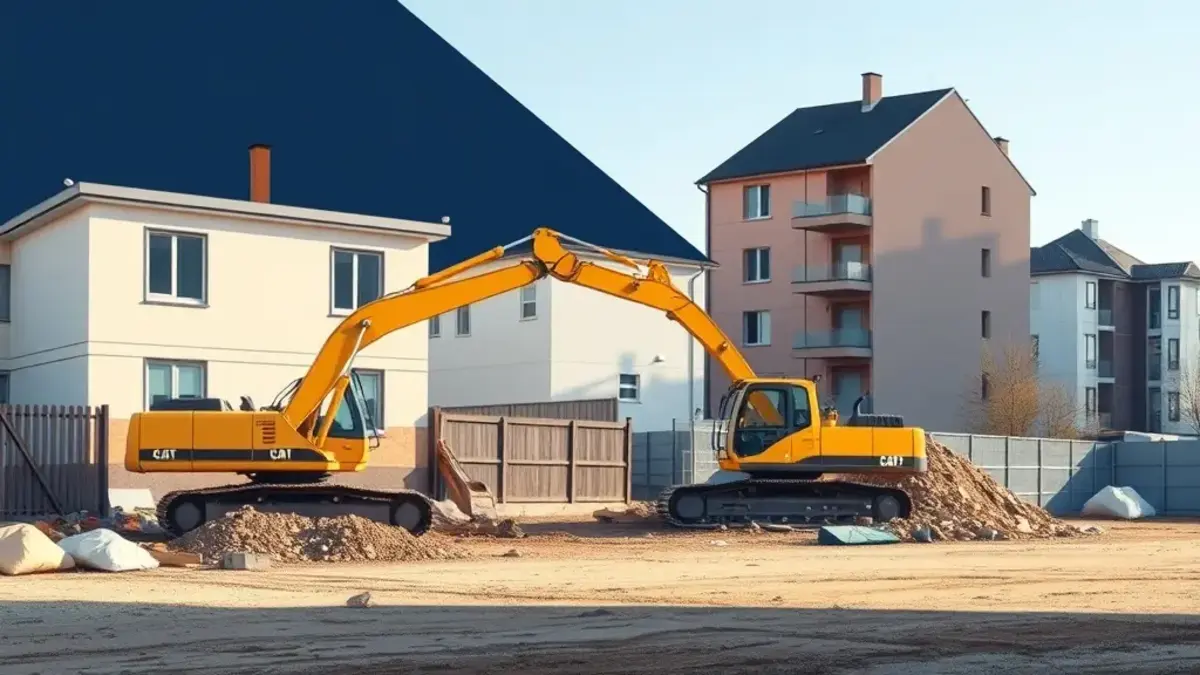
From the start of the site, problems begin. The foundations require deep excavations causing permanent vibrations. The walls of the Martins' villa gradually crack. Construction dust invades their garden and swimming pool. The noise from site machinery, from 6:30am, prevents them from sleeping. The nuisances last eight months.
Mr and Mrs Martin first attempt mediation (attempt at amicable resolution with the help of a third party) with their neighbour Mr Dubois. The latter acknowledges the inconveniences but claims that the construction companies are responsible. For its part, Bâtiments Côte d'Azur SARL responds that it is merely executing the plans of the project owner (the client commissioning the works, here Mr Dubois) and that nuisances are inherent to any building site.
Faced with this impasse, the Martins decide to bring legal proceedings (take to court) both their neighbour owner Mr Dubois AND the construction company Bâtiments Côte d'Azur SARL. They claim compensation for their losses (damages suffered): repair of cracks (estimated at €15,000), compensation for loss of enjoyment of their property (€5,000), and damages for the abnormal disturbance suffered (€10,000).
The first instance court of Grasse rules in favour of the Martins but only condemns the owner Mr Dubois. The construction company is acquitted (released from all liability). Mr Dubois appeals (requests a new judgment before a higher court), considering that liability should be shared with the builders. The appeal court of Aix-en-Provence confirms the first judgment. It is then that the case reaches the Court of Cassation, the highest French judicial court.
The court's reasoning — dissected
The Court of Cassation examines the case with a central question: who can be held liable for an abnormal neighbourhood disturbance? The judges first recall the legal basis: Article 1240 of the Civil Code (formerly Article 1382), which obliges compensation for damage caused by one's fault. But they specify that for neighbourhood disturbance, liability can be incurred without proven fault, as soon as the disturbance exceeds the normal inconveniences of neighbourhood.
The magistrates' (judges') reasoning develops in three stages. Firstly, they confirm that the owner of the building causing the nuisances is liable as of right (without it being necessary to prove a fault on their part). Mr Dubois, as owner of the land where the works take place, is the "project owner": he initiated and directed the site. Even if he did not personally operate the pneumatic drills, he is the instigator of the works causing the nuisances.
Secondly, and this is the major contribution of this decision, the Court affirms that the builders (here Bâtiments Côte d'Azur SARL) are also liable. Why? Because they have the status of "occasional neighbours" of the aggrieved owners. In other words, by intervening on the site, they create a temporary but real neighbourhood relationship with the Martins. Their professional activity on the site makes them directly liable for the nuisances they generate.
Thirdly, the Court quashes (annuls) the appeal court judgment which had exonerated the builders. It specifies that the liability of the project owner (Mr Dubois) does not exonerate (release) the companies. Both can be condemned jointly and severally (each can be held to pay the totality of damages). What few people know: this joint and several liability means that victims can turn to the one who is most solvent (has the means to pay), often the company rather than the individual owner.
In short, this decision establishes dual liability: that of the owner who orders the works AND that of the professionals who execute them. An important evolution in case law, strengthening protection for victims of nuisances.
What this changes for you — concretely
But what exactly does this change in your life as a property owner, tenant, or real estate professional? Let's see the practical implications profile by profile.
If you are a property owner suffering nuisances (like the Martins in Cannes), this decision gives you more recourse. You can now take action against the neighbouring owner AND against the construction companies. Concretely, this increases your chances of obtaining redress, especially if the neighbouring owner has limited means. undefined in Grasse, I have encountered cases where the construction company, insured and solvent, settled damages quickly while the individual owner dragged their feet.
If you are a property owner having works carried out (like Mr Dubois), beware: you can no longer hide behind your companies. Even if you have entrusted the works to professionals, you remain liable for nuisances caused to your neighbours. You must therefore be particularly vigilant in choosing your companies, defining site hours, and implementing mitigating measures (anti-dust tarpaulins, limitation of noise nuisances). A poorly managed site in Sophia-Antipolis can cost you dearly: count between €5,000 and €50,000 in damages depending on the extent of losses.
If you are a tenant suffering nuisances, you can also take action, but indirectly. You must first inform your landlord (your lessor), who can initiate action against the neighbour and builders. Your landlord has the obligation to guarantee your peaceful enjoyment of the premises. If they do not react, you could request a rent reduction or even terminate the lease.
If you are a construction professional (architect, building company), this decision concerns you directly. You are now considered an "occasional neighbour" and thus potentially liable for disturbances caused. This should encourage you to strengthen your precautions: strict respect of legal hours (generally 8am-12pm and 2pm-7pm on weekdays, prohibition on Sundays), implementation of protections, prior information of local residents. A company neglecting these aspects risks not only financial condemnations but also damage to its reputation.
However, beware: for liability to be incurred, the disturbance must be "abnormal". Minor temporary inconveniences (a few days of moderate noise) are not sufficient. There must be significant, lasting nuisances, exceeding normal inconveniences of life in society.
Four tips to avoid this type of dispute
- Before starting works, inform your neighbours in writing: send a registered letter with acknowledgement of receipt detailing the nature, expected duration, and planned mitigating measures. Propose a meeting to discuss their potential concerns. This preventive approach can avoid many conflicts.
- Choose serious and insured companies: check their references, their decennial insurance (guarantee on disorders affecting the building's solidity), and require they take out building damage insurance. Include precise clauses in the contract on nuisance management and penalties for non-compliance.
- Document everything: if you suffer nuisances, take dated photos of disorders (cracks, dust), note exact times of noise nuisances, keep exchanges with neighbours or companies. These proofs will be crucial in case of proceedings.
- Attempt mediation first: before engaging costly and lengthy legal proceedings (often 2 to 3 years), propose mediation. Many town halls, like that of Grasse, offer this service free or at low cost. An amicable agreement is always preferable to a judgment.
Deepening: related case law and evolutions
The 2005 decision fits into a constant evolution of case law on neighbourhood disturbances. Before it, a 1999 decision (Court of Cassation, 17 November 1999) had already established that the owner was liable for disturbances caused by their tenants. But it is indeed the 2005 ruling that clarified builders' liability.
Since then, courts have continued to specify the framework. For example, a 2015 decision recalled that to incur builders' liability, they must have committed a fault in executing the works. But the mere existence of an abnormal disturbance can constitute this fault. The trend is clear: judges increasingly protect victims of nuisances, by widening the circle of potential liable parties.
What this means for the future? Probably increased vigilance from all actors. Owners will need to better supervise their sites, companies will need to strengthen precautions, and victims will have more ease obtaining redress. In a context where urban densities increase, particularly around Sophia-Antipolis, this case law offers an essential protective framework.
Checklist before taking action
You suffer nuisances and are considering taking action? Here is what to check:
- Is the disturbance truly abnormal? Compare with what neighbours normally suffer in your area. Occasional renovation works do not justify action, but intense and prolonged nuisances (several months) probably do.
- Do you have proofs? Photos, bailiff's reports, testimonies, exchanged letters. Without proofs, your action risks failing.
- Have you attempted dialogue? A formal registered letter to the owner and companies is often a necessary prerequisite before any legal action.
- Do you know the time limits? You generally have 5 years from discovery of damages to act. But better not wait: the earlier you act, the more chances you have to limit losses.
- Have you evaluated the cost? Legal action costs (lawyer fees, bailiff fees, expert fees). But often, a simple serious formal notice suffices to obtain an agreement.
You find yourself in a similar situation? A first 30-minute consultation with Maître Zakine (€45) can save you months of proceedings — and often much more. Book an appointment →
Useful resources on cecile-zakine.fr
📌 Does this apply to your situation? Maître Cécile Zakine, lawyer in French real estate law, practises throughout France.
→ Avocat servitudes & foncier |
→ Browse all our legal articles
