Reference decision: cc • No. 08-10.415 • 2009-03-04 • View the decision →
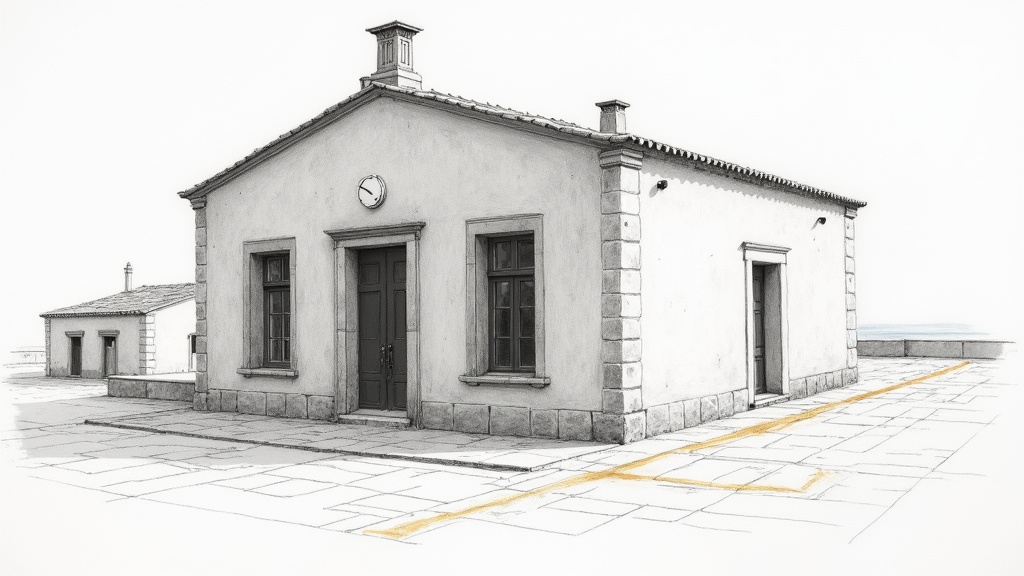
Imagine the scene: you own a house in Sophia-Antipolis, your only access to the road is via your neighbour's path. For years, everything goes well. Then one day, without notice, your neighbour puts up a barrier and blocks your passage. What to do? Go to court, of course. But which one? The interim relief judge (possessory) or the trial judge (petitory)? And if the interim relief judge tells you: "Come back when the trial judge has decided the question of the landlocked property"? That is exactly what happened in this case, and the Court of Cassation said: no, the possessory judge cannot make his decision depend on what will be decided in the petitory. In other words, he must rule alone on the protection of possession, without waiting for a debate on the right of ownership. A decision that clarifies the rules of the game for thousands of owners.
The facts: a story that happens every day
Mr and Mrs X are owners of a plot in Valbonne, in the hinterland of Grasse. Their land is landlocked: it has no direct access to the public highway. To get out, they have always used a path that crosses Mrs Y's property. Until the day Mrs Y decides to block this passage, claiming that the landlocked situation has disappeared: Mrs Y has in fact acquired a neighbouring plot which, according to her, now gives Mr and Mrs X sufficient access. They apply to the interim relief judge (possessory judge) to have the passage restored. The judge rules in their favour at first instance, but the Court of Appeal reverses this decision. Why? Because, according to the Court of Appeal, the petitory judge (the judicial court) must first establish the disappearance of the landlocked status. In other words, the possessory judge referred the matter to another judge, creating a judicial "ping-pong" situation. Mr and Mrs X appeal to the Court of Cassation.
The reasoning of the court — explained
The Court of Cassation quashes the appeal judgment. Its reasoning is simple: the possessory judge (interim relief judge) is competent to protect possession (peaceful enjoyment of a property) without having to rule on the right of ownership. Article 1264 of the Code of Civil Procedure (which governs possessory proceedings) provides that the possessory and the petitory are independent. In clear terms, the possessory judge must decide the question of possession within one year of the disturbance, without waiting for the trial judge to rule on the existence or not of an easement. In this case, the Court of Appeal had examined whether the landlocked status had disappeared (a substantive issue) to decide the fate of the possession. However, this was an error: it should only have verified whether, in the year preceding the disturbance, Mr and Mrs X peacefully possessed the right of way. It does not matter that the landlocked status ended by an acquisition, as long as the possession was established. The Court of Cassation thus recalled a fundamental principle: the possessory judge cannot make his decision depend on a petitory action. This is neither an evolution nor a reversal, but a confirmation of the classic rule. However, this decision is important because it sanctions a frequent practice of courts which, out of caution, refer to the merits.
What this changes for you — concretely
If you are the owner of a landlocked property and your neighbour blocks your access, you can act quickly. For the owner suffering the disturbance: you do not need to wait months or years for the trial judge to rule on the existence of an easement. You can apply to the interim relief judge (judicial court) to have your passage restored within a few weeks. For example, in Valbonne, if your neighbour installs a gate, you can ask for its removal by injunction. For the owner who blocks the passage: be careful, you cannot invoke the disappearance of the landlocked status to justify your obstruction without a decision from the trial judge. If you take the initiative, you risk being ordered to restore the passage under a penalty payment (for example €100 per day of delay). For the buyer: before buying a landlocked property, check whether there is a title (notarial deed) or thirty-year possession (adverse possession). Otherwise, you may need to bring an action on the merits to obtain an easement. But in the meantime, you are protected by the possessory action if your possession is peaceful and continuous.
Four tips to avoid this type of dispute
- Keep evidence of your passage: photos, neighbour statements, invoices for maintenance of the path. In case of disturbance, you will need to demonstrate that you had been passing for at least one year.
- Never block a passage on your own initiative: even if you believe the landlocked status has disappeared, wait for a court decision. Blocking exposes you to damages.
- Prefer a written passage agreement: a notarised agreement (conventional easement) avoids any dispute. Provide for an indemnity and maintenance conditions.
- In case of disturbance, act quickly: the possessory action must be brought within one year of the disturbance. After this period, you lose the rapid protection of the injunction.
Further reading: related case law and developments
This decision is in line with consistent case law. Already in 2003 (Civ. 3e, 18 June 2003, n°02-12.345), the Court of Cassation ruled that the possessory judge cannot subordinate his decision to the outcome of a petitory action. More recently, in 2018 (Civ. 3e, 6 September 2018, n°17-21.456), it specified that even in the presence of a forfeiture clause in a lease, the interim relief judge must assess possession without waiting for the merits. The trend is therefore clear: trial judges must respect the autonomy of the possessory action. For the future, this rule could be strengthened by the reform of civil procedure, but the current balance seems satisfactory. Note, however, that the possessory judge can still examine questions of fact, such as the existence of apparent possession, but cannot decide a right of ownership.
Checklist before acting
FAQ
- Can I apply to the interim relief judge if my neighbour has blocked my passage for more than a year? No, the possessory action is subject to a one-year time limit from the disturbance. After that, you must bring an action on the merits.
- What if my neighbour claims that the landlocked status has disappeared? Apply to the interim relief judge for him to recognise your possession. It is up to him to decide, without waiting for the merits.
- What is the cost of a possessory injunction? Expect approximately €1,500 to €3,000 in lawyer's fees, plus procedural costs. Urgency often allows a hearing within 2 to 3 months.
- Can I obtain damages for the disturbance? Yes, but this is a matter for the trial judge. In interim relief, you can obtain an advance on damages if the disturbance is manifest.
Are you in a similar situation? A first 30-minute consultation with Maître Zakine (€45) can save you months of proceedings — and often much more. Book an appointment →
📌 Does this apply to your situation? Maître Cécile Zakine, French real estate lawyer, practises throughout France.
servitude-droit-passage-avocat/" rel="dofollow">→ Avocat servitudes & foncier |
→ Browse all our legal articles
